Greg Semple’s thriving fish breeding business gradually declined over 15 years. Photo: Supplied.
A 70-year-old Wagga man who has spent almost a decade without income after his fish breeding business was devastated by suspected PFAS contamination says he will “never give up” his fight for compensation from the Federal Government.
Aquaculture expert Greg Semple moved from Sydney to the Riverina to purchase the Murray Cod Hatcheries in 1996, when the site was a thriving aquaculture operation producing hundreds of thousands of fish.
But over time, he began seeing unexplained and worsening deformities in stock.
“I noticed some silver perch that had twisted bodies and deformed heads,” he said.
“Later, it affected the catfish – they looked like corkscrews, they had shortened body lengths and twisted spines.”
He said fish breeding continued to decline over the following years until the business eventually collapsed.
PFAS contamination pollutes water supply
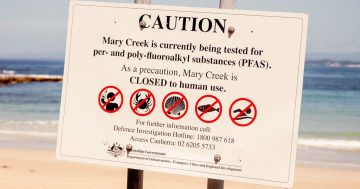
In 2017, the Department of Defence advised him that testing had identified PFAS contamination in groundwater and surface water on and around his property, which is believed to have originated from nearby RAAF Base Wagga.
PFAS (per- and poly-fluoroalkyl substances) are a group of long-lasting synthetic chemicals used in firefighting foams and industrial products. They are often referred to as “forever chemicals” because they do not readily break down in the environment.
Between the 1970s and 2004, the Australian Defence Force widely used aqueous film-forming foam in firefighting training, which contained PFAS chemicals.
Mr Semple believes the risks were known much earlier.
“There was an international warning about PFAS widely acknowledged back in 2002, the Department of Defence would have known and they could have told us back then. I could have moved and started breeding in another location.”
Instead, he says his business was gradually destroyed over more than a decade, costing him millions of dollars.
Without access to uncontaminated water or any viable way to remediate the property, Semple ceased aquaculture and other farming operations in 2018.
Professor Ian Rae, an expert on chemicals in the environment at the University of Melbourne, has noted Mr Semple’s was the worst case of damage caused by PFAS contamination that he had seen across Australia.

Mr Semple noticed deformed fish from 1997. Photo: Supplied.
Exhausting legal fight
In 2024, Mr Semple commenced proceedings against the Commonwealth in the NSW Supreme Court seeking compensation for what he says are extensive personal and business losses.
Commonwealth agencies are obliged to comply with so-called “model litigant” obligations, which require them to act fairly, avoid unnecessary delay, not take advantage of a claimant’s lack of resources, and attempt to resolve disputes where possible.
Mr Semple says the Commonwealth has done the opposite.
“I’ve helped them every step of the way and they have done nothing but been difficult to deal with,” he said.
“I’ve requested basic documents, like those that tell me how much of this chemical was used on this base and at what time. But they refuse to hand them over.
“We are talking about old firefighting information from 30 years ago. There are no national security concerns.”
He estimates he has provided more than 4000 documents in the course of litigation, describing the process as “a full-time job” with no income preparing evidence and reports for his case.

The Murray Cod Hatcheries were once an iconic destination in Wagga. Photo: Chris Roe.
‘Hypocritical’ Commonwealth action against PFAS manufacturer
Last month, the Commonwealth launched legal action in the Federal Court against 3M Company, which manufactured PFAS-containing firefighting foams, seeking to recover costs linked to contamination across 28 Defence sites nationwide, including Wagga.
Mr Semple described this as “hypocritical”, saying that if the Commonwealth acknowledged the PFAS damage in its case against 3M, it should also compensate the victims of its own contamination rather than continuing to deny responsibility for their losses.
“On the one hand the Commonwealth is pursuing a claim against 3M which in part relates to future expenses it expects to incur for investigating and managing PFAS contamination. On the other, the Commonwealth denies that it is in anyway responsible for the losses Mr Semple has suffered and has not paid him a cent. The inconsistency is hard to ignore,” Maddens Lawyers principal lawyer Kathryn Emeny, who represents Mr Semple, said.
Region asked the Department of Defence to explain the apparent inconsistency, and why key documents had not been provided to Mr Semple.
A spokesperson did not answer these questions, but provided the following statement:
“The Commonwealth’s legal action against 3M Australia Pty Ltd is focused on the Commonwealth recovering taxpayer costs arising from current and future environmental, economic, and cultural impacts caused by 3M’s products containing per- and polyfluoroalkyl substances (PFAS),” the spokesperson said.
“The legal action is brought in relation to PFAS contamination and remediation at 28 Defence bases across Australia and does not relate to personal injury. Defence is committed to supporting communities impacted by PFAS contamination on and around Defence sites.
“As the matter is now before the Federal Court of Australia, it would not be appropriate to comment further.”
Mr Semple says he believes the legal process is designed to exhaust him. He remains living on the Wagga property, forced to dedicate his life to a legal fight that never seems to end.
“It’s a lot of work for an old man but I hope to live long enough to see this out. They’re trying to wear me down and hope I quit, but I’ll never give up,” he said.
Original Article published by Oliver Jacques on Region Riverina.