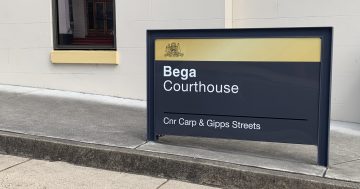
The matter was heard before the Albury District Court: Photo: Vanessa Hayden.
CONTENT WARNING: This story contains details that may distress some readers.
A southern NSW woman who caused “horrific injuries” by burning a friend after a misogynistic comment telling her she should be “making scones”, will serve her original sentence.
In May 2025, NSW District Court Judge Jennifer English sentenced Corbie Jean Walpole to a seven-and-a-half-year prison sentence.
She had pleaded guilty to a charge of burning or maiming a person by using corrosive fluid.
A three-judge panel from the NSW Court of Criminal Appeal recently rejected her bid to overturn the sentence.
On 6 January 2024, Walpole was 23 and with a group of friends at the Howlong Golf Club.
The group included the victim, then-22-year-old Jack Loader, who is also from the Riverina region.
She and her partner had arrived at the venue at about 8 pm, when they started drinking. Walpole, along with others in the group, was also using cocaine.
Much later that evening, the group had moved to Walpole’s house in Howlong, in southern NSW.
At about 5 am on 7 January, Mr Loader told her repeatedly that she should be in the kitchen making scones, rather than out partying.
Following those comments, Walpole picked up a red plastic petrol container and poured its contents over the victim before holding a lighter up.
“[She] said words to the effect [of] ‘I’ll do it! I’ll do it!’ … The victim said words to the effect, ‘Go on, do it!'” the decision stated.
She then ignited the petrol, setting Mr Loader alight.
Others at the scene tried to extinguish the flames by using a dog bed and immersing him in water, while she left the home.
The three judges ultimately found that Walpole’s actions fell above the mid range of seriousness for similar offending.
“To the extent that the applicant relies on the misogynistic comments or antagonism between the applicant and the victim as provocation, or as leading to the offending … [neither] provides any excuse or any real explanation for that which occurred.
“The applicant’s response was, on any view, wholly disproportionate to the comments made by the victim.”
Mr Loader was ultimately taken to a nearby hospital in NSW, before being airlifted to the Alfred Hospital in Melbourne.
He had second- and third-degree burns to more than 60 per cent of his body, was in an induced coma for eight days and needed 10 operations.
In her appeal, lawyers for Walpole argued she had been denied procedural fairness, with Judge Jennifer English not properly considering her mental health before and after the offending.
The lawyers argued that Judge English didn’t account for a “causal nexus” between her mental health and the offending when sentencing Walpole.
During the initial court proceedings, her lawyers relied on a forensic psychologist’s report that found she was depressed and using substances to manage symptoms.
The court heard she was using cocaine almost daily before the offending and was regularly drinking to excess.
The expert report also found Walpole has PTSD as a result of her offending, with the lawyers arguing this should be considered during sentencing.
In their judgement, the three appeal judges found PTSD didn’t amount to a mitigating factor for Walpole.
“Violent crime has a significant impact on its victims, but it is also not unusual for the offender, on a full realisation of what he or she has done, also to be significantly impacted by the events,” they said.
“In our view, unlike other cases dealing with extra-curial punishment, the offender (in this case, the applicant) is not suffering extra-curial punishment, … That illness might be taken into account in other ways but we do not consider that it should be considered as a form of extra-curial punishment, leading to discounting in the sentence.”
Ultimately, the three appeal judges found that while Walpole’s mental health did have a causal link to her offending, it didn’t reduce her moral culpability by “any great extent”.
“That someone who is depressed indulges in excessive alcohol consumption and use of drugs, which leads to violence of the kind that had occurred does not significantly reduce that person’s moral culpability for such an objectively serious offence and does not in our opinion lead to a lesser sentence in this case.”
Her actions were deliberate and also risked causing harm to others at the Howlong home, they found.
“While the offending was not premeditated … there was time for the applicant to have refrained from taking the final step (of striking the lighter),” they said.
The appeal judges accepted that Walpole was remorseful, had family support, started counselling and has been sober from alcohol and illicit drugs since her offending.
They described her as having “excellent” prospects of rehabilitation.
Walpole’s earliest parole date is in November 2029.
Original Article published by Claire Sams on Region Riverina.