

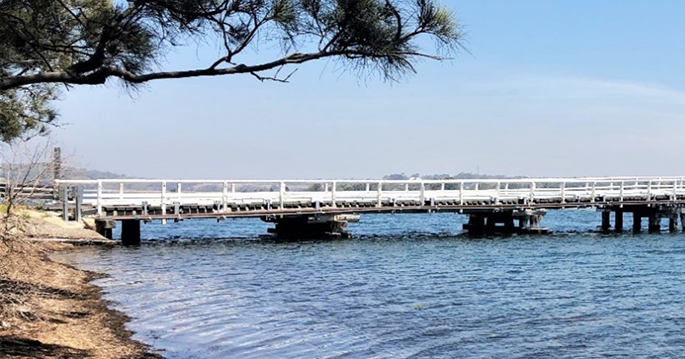
Wallaga Lake has very low levels of microplastic contamination. Photo: Transport for NSW.
The good news is the coastal waterways of the Eurobodalla and Bega Valley Shires have among the lowest levels of microplastic contamination in NSW.
The bad news is that the state’s microplastic contamination of estuaries sits towards the middle of globally reported values.
They are comparable to urbanised systems in China but remain below the most extreme contamination hotspots reported worldwide.
Wallaga Lake on the Eurobodalla/Bega Valley shire borders, Nadgee Lake near the Victorian border and Middle Lagoon in Mimosa Rocks National Parks north of Tathra are among NSW’s five estuaries with the lowest levels of microplastics.
The findings were released by the NSW Environmental Protection Authority in March. The 2021-24 report card on broadscale microplastic assessment was prepared by the Climate Change, Energy, the Environment and Water Department.
It was the first large-scale study of its kind in Australia.
The assessment was undertaken because microplastics – plastic particles smaller than 5 mm – are a priority threat to NSW’s marine estate and there are sizeable knowledge gaps. Microplastics were found in all 120 estuaries sampled over the summers of 2021 to 2024, with foam as used in insulated cups and packaging being a particularly problematic source.
Samples were classified into five categories, with A being the lowest level of contamination and E being the highest concentration.
The state was divided into eight regions. The Mid-North Coast had the lowest level of contamination, Eurobodalla the second lowest, then Bega Valley, followed by the Hunter-Central Coast.
Hawkesbury-Sydney estuaries were the most contaminated, followed by North Coast, Illawarra-Shoalhaven and Northern Rivers.
A very fine mesh manta net, towed by a canoe, surveyed the top 15 cm of surface water. Over the four years, 594 water samples were collected.
They were sieved, digested, density-separated and vacuum-filtered to isolate microplastics from organic matter. Almost 32,000 microplastic particles were counted.

Map showing the Eurobodalla coastal waterways that were assessed. Photo: NSW EPA.
The sampling indicated that the Eurobodalla had low to moderate microplastic contamination. Over the four years, 58 samples were taken from 13 waterways.
Five waterways were graded B: Clyde River, Moruya River, Coila Lake, Wagonga Inlet and Tilba Tilba Lake.
Durras Lake, Batemans Bay, Meringo Creek, Tuross River, Lake Mummuga and Corunna Lake were graded C.
Tomaga River and Congo Creek were graded D.
The report said that overall, Eurobodalla had low levels of microplastic contamination, except for isolated hot spots where higher levels were found. It said those hot spots seem to be caused by site-specific sources that can be managed.

Map of Bega Valley’s coastal waterways. Photo: NSW EPA.
The Bega region was also rated as having low to moderate microplastic contamination after taking 58 samples from 15 waterways.
Nadgee Lake and Middle Lagoon had consistently very low levels. Across NSW, they ranked second and third for lowest contamination. The report said those low readings reflected their minimally disturbed catchments.
Also relatively less contaminated were Wallaga Lake, Towamba River, Wonboyn River, Merrica River and Nadgee River. They were graded B.
The waterways that were graded C were Wapengo Lagoon, Bega River, Wallagoot Lake, Pambula River and Nullica River.
The report said while overall contamination was low, Bermagui River, Merimbula Lake and Twofold Bay had grade D concentrations, suggesting human activity had caused pollution or environmental change.
“These findings highlight the influence of catchment disturbance on microplastic loads and the role of pristine lagoons as reference sites,” the report said.
Across all the NSW samples, 68 per cent were the smallest ones examined, measuring 0.25 to 1 mm.
The two largest sources of microplastics were expanded plastic foam materials such as foam cups, packaging and insulation and fragments from broken down hard plastic objects like bottles or containers. Foam and fragments each accounted for 37 per cent of the microplastics.
A further 19 per cent came from film, namely fragments of soft plastic materials from plastic bags and packaging. These are typically thin, transparent and flexible.
Five per cent came from artificial turf and two per cent from pellets, the raw materials used in industrial plastic production.
The report’s recommendations included targeting priority sources of foam packaging which will be regulated or phased out; artificial turf fragments that will be contained and phased out; and pellets which will be contained and handling enforced.
The report also recommended broadening the scope to microplastics smaller than 0.25 mm, long-term monitoring, developing national standards and ecosystem impact studies.
A focus on urban catchments, prioritising Hawkesbury-Sydney and polymer risk assessment are also recommended as a result of this baseline report.








