The Berrigan Bush Fire Brigade, March 1901. Thirty members of Australia’s pioneering volunteer fire brigade pose with horse-drawn tankers and equipment. Led by Captain WA Ritchie (centre), this group from NSW laid the foundational roots for what would eventually become the NSW Rural Fire Service (RFS). Originally published in the Sydney Mail.
Long before a harvest safety alert stopped a header, a bell beneath the archway of Berrigan’s Royal Hotel summoned the members of what became NSW’s first formally recorded volunteer bush fire brigade.
“As soon as the bell rings each fireman runs to the rallying spot,” Melbourne weekly The Australasian reported in January 1901.
A pair of horses hauled a drag carrying up to 16 men towards the smoke, followed by a water cart to tackle burning trees and stumps and a third carrying drinking water and refreshments.
At the fire front, volunteers smothered flames with long-handled beaters.
It was a carefully planned response in an age when news of a fire was tapped out in Morse code, carried along telegraph wires and decoded by an operator before being passed to the brigade.
The Australasian congratulated the town on a movement it said, “ought to be extensively adopted throughout Australia”.
That system put Berrigan, in the southern Riverina about 22 kilometres east of Finley and 36 kilometres north of Cobram, at the beginning of volunteer bush firefighting in NSW.
The NSW Rural Fire Service (RFS) traces that history to a meeting at the Royal Hotel in November 1900 – the state’s first official record of a formal bush fire brigade – but newspapers show coordinated efforts around Berrigan began earlier.
European pastoral settlement dates to 1849, when Robert Rand established the 22,500-acre Momalong Station.
As smaller farms spread across the open country, settlers also discovered how quickly fire could travel.
On 6 December 1887, a swaggie was said to have discarded a burning match after lighting his pipe on William Quade’s property.
The resulting fire swept across an estimated 40,000 acres, with The Weekly Times calling it the most disastrous fire yet experienced in that part of the colony.
Within two years – and before Berrigan had been proclaimed a village – landholders were organising.

On 14 November 1889, The Sydney Morning Herald reported that, “graziers and farmers in the neighbourhood of Murray Hut and Berrigan” had formed a bush fire brigade. Source: Trove
On 14 November 1889, The Sydney Morning Herald reported that, “graziers and farmers in the neighbourhood of Murray Hut and Berrigan” had formed a bush fire brigade (Murray Hut being the settlement from which present-day Finley developed).
The danger they feared came from abundance rather than drought with one newspaper suggesting, “an exceptionally luxuriant growth of vegetation could allow any outbreak to assume alarming dimensions”.
The following day, the Albury Banner and Wodonga Express detailed that captains had been nominated and horses, pump-equipped water carts and axes placed on standby.
These reports provide early evidence of a coordinated district response, although it’s unclear how long that organisation remained active.
Berrigan’s own bush fire brigade history picks up seven years later, with a mural proudly proclaiming 1896 as the foundation date.
A history first published in Melbourne’s Age and republished by the Albany Advertiser in 1936 said Scottish baker John Thomson called a well-attended meeting that December.
Volunteers, most of them businesspeople and shop assistants, agreed to cover a 10-mile radius around Berrigan.
About noon the following day, the new brigade was called to almost 600 acres of burning self-sown wheat about 12 miles from town.
With no purpose-made beaters, volunteers pulled branches from nearby trees.
The founding member remembered shouting “beat in, not out” at a commercial traveller whose blows were spreading the flames, trapping a lieutenant who had to jump through the burning crop to escape.
Experience produced better equipment, firstly better beaters, as corn sacks were folded into four, strapped to hoe handles and stored in brine to prevent them catching alight. Rawhide later replaced the sacks, but still required a sliding stroke to avoid throwing sparks ahead of the fire.
On 20 November 1900, Berrigan put the response on a firmer footing at the Royal Hotel.
Half of the 60 men present enrolled, officers were elected and promises of horses and equipment secured.
The brigade later divided its crews into nine-man teams. Three men beat the flames, three followed to extinguish anything missed and three rested before rotating forward. One crew reportedly covered almost eight miles of fire line without stopping.
An armband bearing the brigade’s initials served as its only uniform. Thomson became provisions officer, moving between crews with bread and cheese.
Impressed by the brigade’s work, landholders subscribed enough money for a four-wheeled cart carrying a 180-gallon water tank, pump, hoses, axes, torches and watering cans. The outfit reportedly cost £32.
Progress was not uninterrupted. An attempt to revive the brigade in 1917 attracted only three or four townspeople and no farmers, showing how difficult it remained to keep volunteers, horses and equipment ready.
The brigade nevertheless endured. In December 1921, newspapers reported it joining several hundred people fighting a fire at Momalong.
Over the following decades, council and state support gradually replaced the community subscriptions that had bought its first equipment.
Berrigan’s first radio arrived in 1962, but its firefighting gear remained modest.
When Ian Fox joined in 1968, the brigade used two 200-litre tanks mounted on a ute and a hand pump, which he operated while other members worked the hose. His wife, Inara, joined in 1970.
In 1997, Berrigan became part of the newly established NSW RFS, which brought the state’s locally controlled brigades into a single organisation.
Berrigan’s double-bay station, built in 1999 to house two Category 1 tankers, was officially opened during its centenary celebrations in April 2001.
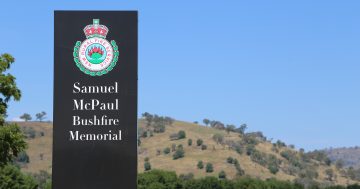
Then NSW emergency services minister Bob Debus, RFS Commissioner Phil Koperberg and Berrigan Shire mayor John Bruce unveiled a memorial declaring the town the birthplace of the first volunteer bush fire brigade.
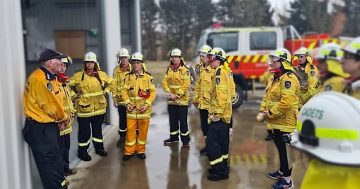
At its 125th anniversary in September 2025, heritage vehicles stood beside the brigade’s three modern appliances. Ten life memberships were awarded and more than 440 years of combined service recognised.
The brigade now belongs to the Southern Border District, covering more than 823,000 hectares across the Berrigan, Federation, Greater Hume and Albury local government areas.
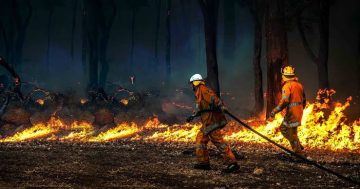
Its crews are supported by tankers, radio and digital communications, satellite imagery, drones, aircraft and cameras monitoring conditions across the region.
The Bush Fire Danger Period began across most of NSW on 1 October and starts in Berrigan on 1 November.
The warning may now arrive through the Hazards Near Me app rather than a hotel bell, but the principle established by the district’s first volunteers remains unchanged: have the people and equipment ready before the smoke appears.