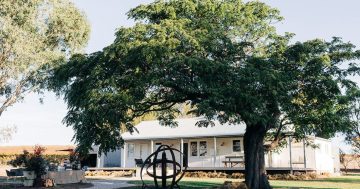
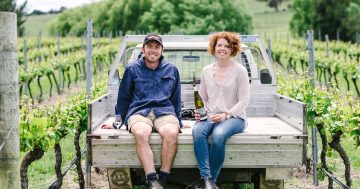
Freeman Vineyards owner Dr Brian Freeman, daughter Marcelle Freeman and Member for Cootamundra Steph Cooke celebrate a $2 million NSW Government grant to establish the state’s first wine dealcoholisation facility at the family’s winery near Young. Photo: Supplied.
The success of zero-alcohol beer has demonstrated consumers are increasingly willing to embrace alcohol-free alternatives and now Hilltops vigneron Brian Freeman is betting wine can do the same.
A $2 million NSW Government grant announced last week will help him build the state’s first wine dealcoholisation facility, alongside a permanent bottling line, at the family-owned Freeman Vineyards near Young.
The development, designed to create an end-to-end production chain from vineyard to finished bottle, is one of 14 projects funded statewide through the NSW Government’s Agriculture Industries Innovation and Growth Program, including five in Southern NSW.
If successful, the Young operation could become a one-stop processing hub for wineries across NSW and the ACT looking to expand into the growing no and low-alcohol market.
A former professor of Wine Science at Charles Sturt University, Dr Freeman has spent more than two decades challenging convention in both the vineyard and the winery.
That philosophy has produced wines rarely seen in Australia, including the flagship Freeman Secco, made from Corvina and Rondinella, as well as Australia’s only white Furmint and Italian reds including Sangiovese and Nebbiolo.
For Dr Freeman, the dealcoholisation project is part of a long tradition of Australian winemakers embracing new ideas.
“The Australian wine industry is recognised globally, not just for the diversity and quality of our wines, but also a willingness to adopt new technology – like the screw cap and the bag-in-box format, both Australian inventions,” he said.
“We are innovators and right now we need to think laterally because the industry is facing serious headwinds.”
Dr Freeman said changing drinking habits among both younger and older consumers were creating an opening for lower-alcohol wines.
“The success of quality zero beers flags potential for quality NoLo wines,” he said.
“Wine companies need to be nimble to respond to consumer preferences. So we’re investing in state-of-the-art equipment to meet that perceived demand for lower alcohol wines that have similar appealing aromas and flavours as full-strength wines.”
But there’s another reason the project matters.
Until now, wineries wanting to produce no and low-alcohol wines have largely had to send bulk wine interstate for dealcoholisation, creating an opportunity for the Young operation to offer small-volume contract winemaking services closer to home.
Marcelle Freeman, who is working with her father on the project, said an early trial reinforced the family’s decision to establish the facility in Young.
Freeman Vineyards farms 200 ha across five vineyard sites in the Hilltops.
The winery recently collaborated with Sydney brewery Heaps Normal, which is entering the low-alcohol wine market, on a trial batch of prosecco.
“The initial trial prosecco we made had to be sent interstate in bulk for the alcohol removal process, which has both cost, wine quality and environmental impacts,” she said.
Dr Freeman said keeping every stage of production in one place – from crushing and fermentation through to dealcoholisation and bottling – would help protect wine quality while improving efficiency.
“That efficiency is expected to result in the creation of appealing, high-quality low-alcohol wines from high-quality grapes,” he said.
Central to the development is a vacuum distillation unit capable of removing some or all of the alcohol from wine, giving the winery what Dr Freeman describes as “technical flexibility”.
The process gently heats wine under reduced pressure, allowing alcohol to evaporate at a much lower temperature than usual – between 25 and 30 degrees Celsius – while protecting the original grape aromas and flavours.
The permanent bottling line is the other major component of the investment. Freeman Vineyards currently relies on a mobile bottling service and installing its own line will give the business greater control over production while allowing it to provide a more complete service to contract clients.
In time, the business hopes to supply grapes, make the wine, remove the alcohol and bottle the finished product for other producers, all at the one site.
The investment is expected to create opportunities for local vignerons, as well as wine companies across NSW and the ACT looking to establish or expand no and low-alcohol brands.
Marcelle said additional staff would be required across several areas of the business.
“We’re going to need winemakers, people to work in the winery and if we’ve got a bottling unit we’ll need people to work there as well,” she said.
Member for Cootamundra Steph Cooke said the investment would also deliver broader benefits for the region.
“Establishing NSW’s first dealcoholisation facility right here in Young means more value will be added locally, more jobs can be created locally, and more opportunities will flow to our grape growers and winemakers,” she said.
Freeman Vineyards received the largest of the five Southern NSW grants awarded under the program.
The other recipients were Australian Wool Handlers in Goulburn, which received $1.4 million for a digital wool auction facility; Tilba Dairy – $1.1 million to expand cheese, yoghurt and ice cream production; Blantyre Farms in Young – $1 million for an on-farm feedmill using food waste and by-products; and Aviagen in Goulburn – $675,000 for advanced egg-fertility imaging at its hatchery.
Dr Freeman believes the investment comes at an important time for the industry.
“The Australian wine sector is currently facing significant challenges, with supply outstripping demand,” he said.
“Some Hilltops vineyard areas have been mothballed or removed but others are being renovated; new varieties are being planted, or expanding, like our Freeman Prosecco vines.
“It’s always been a cyclical industry. The tricky bit is always timing investment in new cycles and right now I see growth in lower-strength wines.”