Harden’s Jess Ryan (right) after her election to the NSW Farmers board with newly elected president Rebecca Reardon (left), who was born and raised in Cootamundra, and Cootamundra MP Steph Cooke. Photo: Steph Cooke.
Harden farmer Jess Ryan has become the youngest person elected to the NSW Farmers board as Southern NSW farmers claimed four key leadership positions within the state’s peak farming body.
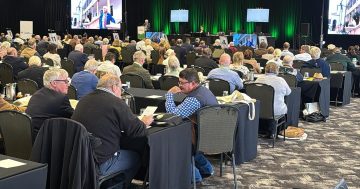
Ms Ryan, 24, who chairs the NSW Young Farmers Council, won one of three contested director positions at the NSW Farmers 2026 Annual Conference at Rosehill Gardens in Sydney.
On Wednesday night (22 July), Ms Ryan’s achievement was recognised closer to home when she was presented with a Hilltops Council Community Recognition Award.
In congratulating her, Hilltops Council described her election to the NSW Farmers board as a significant achievement for the district and the next generation of agricultural leaders.
Hilltops Mayor Brian Ingram said it was encouraging to see young people becoming involved in agriculture and taking on leadership roles.
“It was very refreshing and rewarding to see youth involved in the farming sector,” Cr Ingram said.
“But to step up to a position on a board at such a young age has to be commended. Congratulations on that.”
Cootamundra-born farmer Rebecca Reardon, who now farms near Moree, was elected unopposed as NSW Farmers president, succeeding Xavier Martin after four years in the role.
Brocklesby grain and livestock producer Justin Everitt was elected unopposed as vice-president, while Koorawatha mixed-enterprise farmer Ian McColl was re-elected to a second term on the board.
Southern NSW’s influence extended well beyond the board elections, with regional delegates leading several of the conference’s key policy debates.
Mr McColl, who produces sheep, prime lambs, cattle and grain, emerged as a leading voice in the debate over mandatory electronic identification for sheep and goats.
Delegates backed a call to delay the mandatory rollout from 1 January 2027 until January 2029.
Mr McColl said while NSW Farmers remained committed to electronic identification, he believed the supporting systems were not ready for mandatory rollout.
“If the NLIS database is not fit-for-purpose, then the eID system is not fit for implementation on 1 January 2027,” Mr McColl said.
Delegates also backed a revamp of drought assistance, including incentives to improve on-farm water and fodder storage and greater support for business planning.
They unanimously called on the NSW Government to suspend land tax compliance for land used for primary production until uncertainty surrounding the definition of primary production was resolved.
Firearms regulation was another issue driven by Southern NSW, with Justin Everitt leading calls for changes sought by primary producers.
Mr Everitt said firearms were essential working tools on farms and warned unresolved issues could affect agricultural operations, biosecurity and pest animal control.
Delegates called on the NSW Government to exempt genuine primary producers from mandatory gun club membership requirements, introduce more practical firearm caps, restore merit reviews for licence decisions, provide fair compensation where firearms were surrendered and retain five-year firearms licences.
Vegetation management was another issue championed by regional delegates.
The conference coincided with the NSW Government’s announcement that the Native Vegetation Regulatory Map will come into force across most of the state from 31 August, ending transitional arrangements that have been in place since 2017.
Bland and Temora shires will remain under the current arrangements while an independent scientific review continues.
Delegates from the Barmedman branch, including Keith and Kerrie Rowe, Annabelle Davis, secretary Lisa Minogue and president John Minogue, successfully moved a motion calling for the urgent completion of the review into the Mallee Broombush Critically Endangered Ecological Community listing, arguing affected landholders needed greater certainty over vegetation management.
Renewable energy planning also produced some of the conference’s strongest exchanges.
NSW Minister for Climate Change, Energy, the Environment and Heritage Penny Sharpe addressed delegates before facing questions about the impact of renewable energy projects on productive farmland.
Southern Tablelands farmer and NSW Farmers director David Young challenged the government’s consultation with agriculture, arguing farmers were too often excluded from decisions affecting their land.
Ms Sharpe said renewable energy projects would continue to undergo environmental assessment through the planning process while reaffirming the government’s commitment to expanding renewable energy infrastructure.
The conference also recognised the next generation of agricultural leaders through its tertiary scholarship program.
Harden’s Phoebe Lenehan received the John White Memorial Scholarship, while Olivia Twyford of Bumbaldry was awarded the Paul Lockyer Memorial Scholarship.