For her 15th birthday Teraya Miller donned a heavy leather jacket and Biggles helmet and goggles for her first flying lesson in a Tiger Moth. She now has two flying schools and a Piper Warrior II four-seater plane. Photo: John Thistleton.
On a rainy Saturday afternoon near Goulburn, Teraya Miller looks out of the large window across the aerodrome’s grass runway to the horizon and shakes her head.
She is assessing the convective activity in storms and showers about, and acknowledges people still take the chance of a quick flight, sometimes skipping a flight plan and not checking their fuel before they go.
“I wouldn’t go flying now; you can see there is a shower coming,” the principal of flying schools in Canberra and Goulburn says. “But people push on, they want to get home, they think they can beat the rain, or the storm or the wind,” she says.
In more than 30 years of flying and teaching others to fly, she has never experienced a crash, nor have her numerous students.
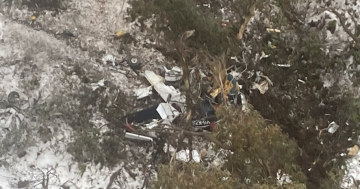
Yet throughout Australia, light plane accidents regularly feature in the news. Twenty-seven people died in 20 light aircraft crashes in 2024, including those flying in home-built planes, crop dusters and helicopters, according to the Australian Transport Safety Bureau.
“Accidents are rarely a result of the aircraft; it is normally pilot error,” Teraya says. Often the accident boils down to the human desire to get home.
“We have fuel-related accidents once every 10 days in this country; it is amazing,” she says. “We don’t run out of fuel in our cars that often, but people seem to do it in aircraft,” says Teraya, who worked for 16 years for the Civil Aviation Safety Authority’s communication and education division as an aviation safety advisor in NSW.

Teraya Miller presenting an air safety seminar at the Central Coast Aero Club in 2017 for the Civil Aviation Safety Authority. Photo: Central Coast Aero Club Facebook.
She still compiles a quiz in Flight Safety Australia, CASA’s flagship safety magazine.
Teraya teaches most of her clients in Canberra but retains a soft spot for Goulburn’s rural aerodrome and grass runway.
“It is quite advantageous learning here, lovely in a rural setting and more of a community feel,” she says from her office, previously occupied by Danny Kennedy, a former agricultural pilot in Goulburn.
“People come in, sit around and have a cup of tea after their lesson and talk to the other pilots and other students,” she says.
This is in sharp contrast to Canberra where students spend an age taxiing and awaiting clearance from a control tower to fly.
When she first arrived in Goulburn in 1994 many of her clients were crusty old sheep farmers, keen to learn how to fly to other properties or attend stock sales. Enjoying high wool prices, they were asking at the aerodrome to meet the instructor.
“Oh, that’s me,” she would say, a slip of a girl aged 21 and fresh out of the University of Newcastle. She had completed a three-year science aviation degree and her commercial training at Cessnock Airport.
Later, she studied of a night for her accounting and commerce degrees to broaden her skills.
“You learn, you grow and if you don’t try to be too big and too brave you grow your little business, you get more confidence and grow a little bit more,” she says.
She employs two full-time and two part-time instructors in Canberra, as well as working there herself and has a student instructor one day a week in Goulburn.
Most of her students are learning to become recreational pilots. Some are in their late teens, others are 55 or older. Few are in their 30s or 40s because at this stage of their lives they usually have a mortgage, small children and little time or money for themselves.
Nevertheless, some keep alive the dream of flying.
“Twenty years later you get a lot of people in their mid-50s who either have flexibility at work to be able to take an afternoon off or are semi retired or on the old public service pension or ones who say, ‘I started learning 20 or 30 years ago and didn’t finish’, and now want to finish it,” Teraya says.

Teraya says teaching newcomers to fly is akin to taking a little baby bird who has never flown before and over a few hours, sending them solo and watching them go off on their own. Photo: John Thistleton.
In an aeroplane’s small, confined cabin, Teraya gets to know her students and fellow instructors and consequently follows their progress in the air.
Some of her former instructors now fly for Qantas or Link Airways. A husband and wife team have returned to India where they work for airlines. Some have bought their own aircraft and are flying around Australia and beyond. A Canadian doctor who once worked in Goulburn has returned home and now has a seaplane.