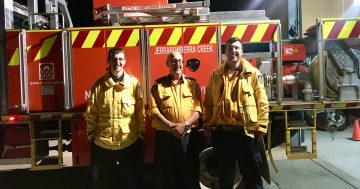
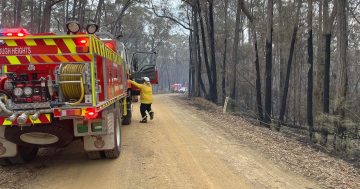
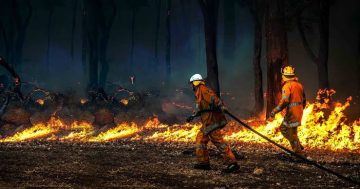
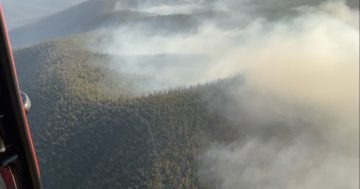
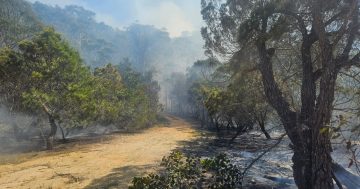
Smoke from the Googong burn-off pushed parts of the ACT’s air quality into the “very poor” category. Photo: Jerrabomberra Creek Rural Fire Brigade.
A massive hazard-reduction burn that blanketed Googong in smoke recently – and briefly pushed Canberra’s air quality among the worst in the country – has left many wondering: How bad does the air have to get before a burn is called off?
Right now, it seems there is no hard line.
An ACT Government spokesperson confirmed with Region “there is no smoke level at which a hazard reduction burn is postponed or paused”.
Instead, decisions are made after a “comprehensive risk assessment” – one that weighs bushfire danger against smoke impacts.

The burn spanned 444 hectares. Photo: Screenshot, Fires Near Me NSW.
The 444-hectare burn near Googong Dam, carried out by ACT Parks and Conservation with support from the NSW Rural Fire Service last week, briefly made Canberra one of Australia’s most polluted cities.
Air quality across the Territory was rated ‘Moderate’ overall, but pollution spikes in suburbs like Civic and Hackett reached ‘very poor’ levels (Air Quality Index figures between 140 and 160).
Googong mother Kara told Region the smoke woke her as it filled her home.
“I was struggling to breathe with my own asthma triggered by the smoke entering our home, and then having to check and treat my children for the same,” she said.
Local daycares responded by keeping children indoors, with one warning parents in an email that “smoke can impact air quality and children’s health, particularly for those with asthma or respiratory conditions”.
The NSW Rural Fire Service say burns “may be postponed or changed depending on prescription, weather conditions and possible impact of smoke”, and has an in-house “Smoke Management Steering Committee” to advise them.
ACT Parks and Conservation Service relies on a “Prescribed Burning Decision Support Tool”.
Adopted in the ACT in 2018 and later by agencies in Victoria, NSW and Tasmania, this digital AI system is designed to “quickly take into account the many factors that need to be considered before a burn takes place”.
“The tool is designed to be used before each day of a burn,” a statement from its launch reads.
“It factors in information including fuel levels, land features, surrounding assets such as houses and stock and the most up-to-date and detailed weather forecasts available from the Bureau of Meteorology.
“Within 30 minutes the tool can … produce a report identifying the risk of the burn escaping, the risk of smoke and the actions that should be considered to reduce those risks.”

The ACT uses a digital tool to predict smoke levels. Photo: Jerrabomberra Creek Rural Fire Brigade.
The government spokesperson added smoke is still a “core consideration”, and that higher-risk burns trigger extra oversight.
“Where a burn is assessed as having a Very High smoke risk, Parks and Conservation Service is required to provide the assessment to the ACT Environmental Protection Authority, and a joint decision is made on whether the burn should proceed, be delayed, or be modified to reduce impacts.
“The Googong burns were assessed as Moderate risk.”
Beyond the smoke itself, residents have also raised concerns about how warnings were handled.
Kara said she received little direct notice.
“As a mother of young children with respiratory conditions, the lack of proactive and direct communication ahead of the burn created unnecessary stress for our household.
“The only information I could find initially was a social media post by one of the local RFS brigades, and no push notifications from the Fires Near Me App, in addition to no direct communication ahead of time,” she said.
“Social media isn’t something that everyone uses, it’s not a reliable form of communication, and it’s concerning that events that affect the health and safety of the community seem to only be available there first.”

Hazard reduction burns in the ACT will pause for ANZAC Day. Photo: Jerrabomberra Creek Rural Fire Brigade.
The ACT Government says notifications were broader than that – including letterbox drops to about 200 homes, direct contact with schools and childcare centres, roadside message boards, radio interviews and updates via multiple agencies.
“Every effort is made to conduct prescribed burns in conditions that minimise smoke impacts on nearby communities. However, some temporary smoke may still occur,” the ACT Government spokesperson said.
“These planned and managed burns play a critical role in protecting Canberra and surrounding communities from the far greater and longer‑lasting impacts of uncontrolled bushfires.”
Information about upcoming prescribed burns can be found at ACT Parks and Conservation.
Original Article published by James Coleman on Region Canberra.