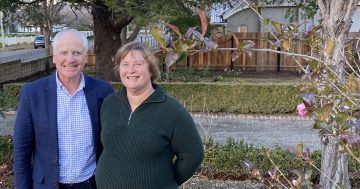
Bruce and Kim Mills with an early Lands Department map which shows William H Broughton’s original block of land and abundant inscribed details. The first clerk of NSW for Governor Lachlan Macquarie, Broughton acquired a 650-acre block adjoining Goulburn’s boundary, marked by Combermere Street. Photo: John Thistleton.
The more they lifted carpets, removed rubbish from their garden and researched, the more Bruce and Kim Mills grew to love their newly acquired heritage home in Hovell Street, Goulburn.
Now the couple has joined Goulburn’s Spring Gardens to share their flowering bulbs, conservatory, beehives and water feature that are a window into the city’s early European history.
‘Garfield House’ will be one of eight gardens open to the public on 17 and 18 October, fulfilling a vision to build appreciation of Goulburn’s exceptional heritage.
From Canberra where they work for the Australian Defence Force, Bruce and Kim bought the secluded old home on a 1400 square metre battle-axe block in 2024.
The ‘for sale’ advertisement indicated it was built in 1880, but a previous owner contacted the Mills to say they knew a family whose grandmother was born in the home in 1840.
They also discovered acclaimed architect EC Manfred had drafted extensions to the home in 1893 and have a copy of his plan.
A grand residence for pastoralists, Garfield House once had three servants and hosted Red Cross fundraising events including golf on the front lawn. A tennis court, circular driveway, stables and tac room underlined its significance.
Divided into three separate flats in the 1960s, and a fourth flat in the stables which now is a neighbouring residence, the home reverted to a single-family one in the 1990s.
Horticulturalist Greta Weyman built the structure of the garden some years ago when she and husband Charles owned Garfield House. The property changed hands several times before Bruce and Kim arrived and gave its exterior a welcome coat of white paint with black trim.
“A lot of the architecture of the garden is Greta’s vision and we have rearranged certain aspects of it and added little features,” Kim said.
“We could be digging in the garden and we’ll find big stumps, or brick paths buried,” she said. Reclaimed bricks now edge gardens and add width to paths.

Bruce and Kim in one of the new trellis sections of their garden with their Labrador Grace and their daughter’s spaniel Dorothy. Photo: John Thistleton.
Kim and Bruce have dug up tonnes of concrete, old pavers and decomposed granite which they wheelbarrowed out. A dilapidated greenhouse made of fibreglass sheeting was also taken away.
They cut back snarls of wire, reinforcement mesh and old rose vines that covered a chook yard.
“The house is now calm and quite controlled. We have replaced the previous tin arches that had collapsed under the weight of roses, shifted unsuitable hedges, and widened paths,” Kim said.
The couple have added a water fountain capitalising on Bruce’s bricklaying skills. They also built a white conservatory in one corner of the garden which shelters a feasting table in readiness for visitors to Garfield House. They will include artists attending paint and pinot sessions and Defence veterans.

A section of the Garfield House garden when bulbs and shrubs are in full bloom. Photo: Sarah Hogan.
Bruce says hedging is the garden’s best feature. “They make it seem you could be anywhere,” he said. “We have seven neighbours and when you sit down in the back garden you cannot see any of them. You can see a couple of rooftops, the mountains in the background, but it’s very secluded and private,” he said.
Crab apple, pepper tree, crepe myrtles, mulberry and several varieties of fruit trees bring colour, shelter and shade to the garden. Three tall ferns reminiscent of the Victorian era rise in one corner facing east.
Previously massive pine trees grew in the hedges and ivy became rampant.
A founding member of the Goulburn Spring Gardens, Adrian Beresford-Wylie said the inaugural event last year drew more than 1100 people to the gardens. About 60 per cent came from outside of Goulburn, helping to change the perception of the city.

Bee hives carry the three different names over the years for Garfield House: Coolatai, Eldon and Garfield. Photo: Sarah Hogan.
“It was incredibly well received by the volunteers who participated in it, many of whom are older citizens,” he said. “They have a deep sense of pride and community in being engaged in this enterprise.”
This spring an event hub at St Saviour’s Hall, 170 Bourke Street, Goulburn, will include ticket sales, plant stalls, arts and crafts stalls and a History Goulburn stall. Devonshire tea, coffee and light lunches will be available.
The eight gardens open between 10 am and 4 pm on 17 and 18 October. You can buy a single $5 ticket or one to see all eight gardens for $25 (same price from last year). Click here for more details.