Photographer David Gallan is one of the speakers at the event. Photo: David Gallan.
Koala Action Network Far South Coast is inviting everyone to a free community event – Koalas in Our Backyard – in Bermagui for an update on local koalas.
Local experts, some of national standing, will talk about results from recent genetic and disease studies and local surveys using drones and acoustic recorders. They will teach how to enhance koala habitat and mitigate fire risk, and how to record information that will increase knowledge and understanding about local koalas to inform conservation planning.
The Koala Action Network started in the area after the NSW Koala Strategy commenced in 2018. A community event in Bega led to the formation of a steering group of people with backgrounds in conservation and koalas. It aimed to get local involvement and build a relationship between the community and NSW Government.
After a follow-up community event, the Koala Action Network Far South Coast (KAN) was set up as a member group within the Far South Coast Landcare Association.
Geographically, its focus is the coastal range between Dignams Creek and Bega River. KAN member Josie O’Connell said that area had been surveyed since the 1990s, and more consistently since 2007, providing information about the locations of the core breeding koala populations.
Ms O’Connell joined KAN in 2020 after spotting a koala near her home in Tanja.
The field surveys were initially managed by Chris Allen while he was working for NSW National Parks and Wildlife Service (NPWS). The current program now sits with NPWS, but Mr Allen and other KAN members remain connected as a community-led advocacy group for local koala conservation.
In the early years KAN was more closely involved in the field surveys in the Mumbulla and Murrah flora reserves before and after the Black Summer bushfires, coordinating funding and resourcing with other koala partners.
In recent years, government funding is directed towards using drones and acoustic recorders to monitor local koalas, predominantly on national parks reserves.

There are breeding koala populations in the area. Photo: David Gallan.
KAN hopes to fill in the gaps that drones and acoustic recorders miss. Drones, for example, do not capture habitat details, while acoustic recorders only detect male koala bellows. A small community-led program is an option and could also target private land.
Outside of breeding season, koalas live within their own home range. Maturing juveniles eventually must find their own place to settle and will roam until they find it.
Ms O’Connell said that might be partly why they were still unsure of the impact of the October 2023 Coolagolite Road bushfire that tore through where a small breeding population was thought to be situated.
“We have had the odd sighting, but not as much as we would like,” she said. “There have also been sightings in the Mimosa Rocks National Park and possibly Bermagui Flora Reserve.
“We do field reports and help to connect organisations with people who have heard bellows of male koalas during breeding season, with occasional reports more recently from the southern extent of the Bournda Nature Reserve.”
KAN coordinates habitat enhancement projects on private property adjacent to koala habitat, arranging volunteers and funding for property owners in the Coolagolite, Cuttagee, Cobargo and Tanja areas.
KAN also facilitates open days such as the one being held in Bermagui on Saturday 22 August.

A KAN community event held in 2024. Photo: KAN.
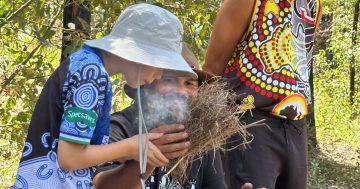
Saturday’s event includes speakers from NPWS and the Living Knowledge Network, the Aboriginal land management group formerly known as Firesticks.
Carolyn Hogg from Sydney University will discuss what they know about koala genetics and how that may assist with koala conservation. Environmental educator Dean Turner from The Crossing Land Education Trust will talk about what to plant where to reduce the landscape’s flammability.
A nationally recognised expert, Mr Allen has been involved in koala work in NSW and Victoria over many years. Roger Park has worked on local koala monitoring programs for many years. He is also a member of Cobargo RFS and will talk about reducing fire risk.
Ms O’Connell will teach people about using the I Spy Koala citizen science app to record koala sightings and the value of citizen science for local koalas.
“Over time we want to get funding to create a community-based team of koala sighting responders to capture the field information that drones and acoustic readers can’t,” she said.
Session 1 starts on 22 August at 10 am and finishes with lunch at 12:30 pm. The second session starts after lunch at 1:30 pm and will finish at 3 pm with a panel discussion. The event caters for all ages. It is funded by the University of Wollongong as part of National Science Week. Register here.