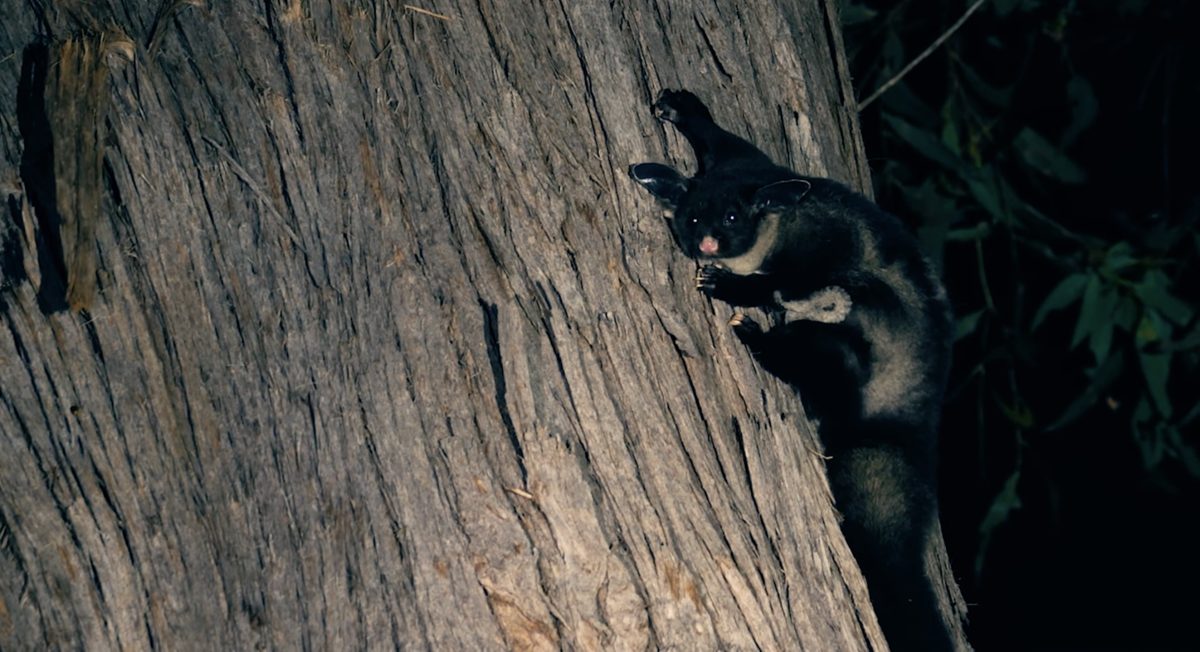
Yellow-bellied Gliders have been living in the forest at Mossy Point for at least 25 years. Photo: File.
Eurobodalla Shire Council has approved a contentious 14-lot subdivision at Mossy Point and an above-height development in Beach Road, Batemans Bay CBD.
Councillors debated the 14-lot Torrens title subdivision at Annetts Parade, Mossy Point for more than an hour. During the public forum of a recent council meeting, four people spoke against the subdivision.
The site is 2.061 hectares and is zoned C4 Environmental Living with a portion zoned C2 Environmental Conservation. The proposal appeared before council because the development application (DA) attracted 59 submissions with 55 objections. About 0.59 hectare of native vegetation will be protected in perpetuity.
C4 zoning permits low-impact development with a minimum lot size of 1000 square metres. It also permits lot averaging if it results in better environmental outcomes.
More than 70 per cent of the site’s vegetation would be removed. It is home to some threatened species including Yellow-bellied Gliders.
The lot was created in 2018 due to a two-lot subdivision. A DA for a 16-lot subdivision was rejected in October 2023. A DA for another 16-lot division was refused in July 2025. Council staff recommended the current 14-lot subdivision DA for approval and said it had been amended to avoid and minimise environmental impacts, particularly biodiversity, bushfire risk and stormwater management.
Among the objections were that while the average lot size was 1300 square metres, 11 of the 14 lots were substantially below 1000 square metres and seven of the 14 lots were less than 600 square metres.
During the public forum Dr Brett Stevenson, co-convenor of A Better Eurobodalla, said the DA relied on lot averaging to undermine the minimum 1000 square metre lot size and would result in irretrievable ecological losses across the whole C4 block.
“It is density driven and mathematically misleading application of lot averaging,” he said. “This isn’t C4. It is perversion of lot averaging. If this goes through it is an invitation to developers to come in and game the system.”

Sketch of the planned development at 43 Beach Road in Batemans Bay. Photo: ESC website.
Another objection was that although all six sap trees and 10 of the 11 habitat trees for the Yellow-bellied Gliders are being retained, with so much surrounding native vegetation and trees being removed, the movement corridor for wildlife would be constrained. Mossy Point residents including Pamela Green and Suzzanne Gray also argued that once houses and roads were built, bringing traffic, light, noise, human activity and domestic animals it would no longer be a functioning ecosystem.
Ms Green asked councillors to consider not whether the DA could be approved, but whether it should be approved. She said councillors must exercise judgment if the DA achieved what was intended for C4 zoning. She said C4 zoning was not intended to maximise residential yield.
During the council meeting councillor Sharon Winslade proposed a lengthy and detailed motion that the DA should be refused. Councillors Mick Johnson, Anthony Mayne and Colleen Turner also spoke against the DA.
Those four councillors voted for the motion to refuse the DA. The other four councillors, Laurence Babington, Phil Constable, Amber Schutz and Mayor Mat Hatcher voted against the motion. With four votes in favour and four votes against, the mayor decided the motion had not been carried. Councillor Rob Pollock was an apology.
They went on to debate the original motion to approve the DA, with Crs Constable and Schutz speaking in favour of the DA.
Cr Schutz agreed with council staff that lot averaging had been used to improve the environmental outcomes. “You have a concentrated living zone and a protected, undeveloped zone which is compatible with lot averaging and C4 zoning,” she said. “This is in keeping with the guidelines in our LEP and DCP.”
She asked council’s planning and environment director Gary Bruce what protection there would be for the gliders’ habitat and feeding trees when the lots were eventually developed. Mr Bruce said there would be notation on the title and that the shire’s regulations to protect Yellow-bellied Gliders would be enforced.
Council staff’s recommendation to approve the DA was subject to 78 conditions. Cr Schutz asked that the condition covering the vegetation management plan was strengthened to protect the habitat and feeding trees and to apply to all lots. Crs Babington, Constable, Hatcher and Schutz voted for the motion to approve. Crs Johnson, Mayne, Turner, and Winslade voted against. The mayor said the motion had been carried.
Turning to the DA for six four-bedroom apartments at 43 Beach Road, Mr Bruce said the main reason for the height variation related to flood management requirements, namely putting parking on the ground floor so that the apartments were above the flood level. The DA was passed unanimously.