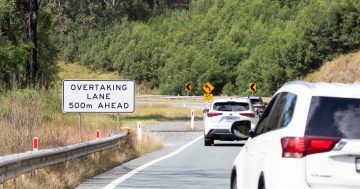
Eurobodalla Shire Council says services can be maintained despite a smaller budget. Photo: Karyn Starmer.
Eurobodalla Shire Council is continually getting more unsealed roads transferred from Crown Lands and traffic volumes are growing, but its budget for maintaining those roads is not being increased accordingly. It means the council must take a different approach.
The council’s infrastructure services director Graham Attenborough explained it to councillors at a 9 June workshop that was open to the public. Central to the approach are safety, council liability and “less planned maintenance and more inspections”.
The shire has 1640 kilometres of roads, of which 815 km are unsealed. The council owns 471 km of those unsealed roads while National Parks, Forestry, Crown Lands and private property owners own the remaining 344 km.
There are two types of maintenance for unsealed roads: maintenance grading and resheeting. Resheeting involves bringing in new materials.
In the financial year ending 30 June, 2026, the council had planned maintenance grading for 405 km of unsealed roads and resheeting of 19 km. It ended up only grading 357 km and resheeting 17.2 km. So, instead of spending $785,000 and $1.346 million on grading and resheeting respectively, it spent $639,000 and $1.289 million.
Mr Attenborough said the council faced several challenges in maintaining its unsealed roads.
“There is expansion of the road network because Crown Lands keeps transferring roads to us, and more traffic flow means more wear,” he said.
There had also been workforce shortages with four grader vacancies during the year; the weather could be too hot, too dry or too wet to carry out maintenance; and reduced available spending.
The council has assigned maintenance frequencies to its unsealed road network. The four categories are: not maintained, maintained as required, annual maintenance, and semi-annual maintenance.
That categorisation takes into account whether the road is maintained by others, bus routes, access to public services, council assets or key industries, whether there are alternative or connecting routes, the number of properties served, traffic volumes, and site condition as determined by inspections or defects.

The council faces several challenges in maintaining its unsealed roads. Photo: File.
As a result, in the 2026/27 financial year, 95 km of unsealed roads will not be maintained, up from 93 km in 2025/26. Thirty kilometres will be maintained as required, down from 47 km in 2025/26, while 300 km will be maintained annually, up from 275 last financial year. The remaining 46 km will be maintained twice a year, down from 56 km in 2025/26.
“The 2026/27 program is a lot more targeted,” Mr Attenborough said. “You can reduce your budget but still maintain the level of service.”
He said that such a risk-based approach and processes supported fair and consistent decision-making, improved transparency in program development, enabled effective prioritisation of limited resources and reduced the council’s liability.
Council staff said the service level of 62 per cent of the roads had not changed; a small number would be decreased and more would be increased.
Mr Attenborough said if a road needed fixing because it was dangerous, council staff would repair it as soon as possible.
Factors included how the road was used, frequency of traffic, whether the defect was large and deep versus narrow and shallow, and how many people were affected.
“The key thing is public safety,” Mr Attenborough said.
Councillor Mick Johnson asked whether it was cheaper to maintain the roads more regularly. Staff said it did not cost extra to rip up the road to remove corrugations.
“Every time they maintain the road, they will determine whether or not to rip it up,” the staff member said.
The following week, council staff held another workshop to discuss the updated pathway strategy. They said they wanted people moving on pathways and there had been a big take-up of e-bikes and scooters.
Council staff carried out some initial consultation in April and May with pop-up sessions, a survey, an interactive map and a project page on its website.
“There are years of submissions and we are sifting through that,” a staff member said. “There is nothing new. It is all the same issues.”
Development criteria for footpaths include safety, demand as determined by proximity to services and population served, attractiveness including shading, width and crossings, and accessibility, such as connectivity to bus stops.
Another councillor workshop will be held in September and the strategy will be presented at the September council meeting for endorsement to go on public exhibition.
Staff said there was only funding for upgrading pathways. For new footpaths, they must apply to the Get NSW Active program for funding or rely on developer contributions.
Cr Phil Constable said those developer contributions meant Narooma was currently funding all the footpaths in Batemans Bay.