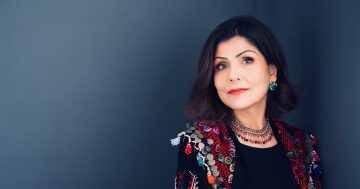
Dr Inga Simpson’s first collection of short stories has been published. Photo: Red Berry Photography.
Dr Inga Simpson’s collection of short stories takes readers deep into nature. It takes them into the worlds of wildlife and gives wild landscapes a voice.
Throughout the exquisitely written stories, Dr Simpson’s connection, care and concern for the environment are palpable.
Dr Simpson’s first collection of short stories was a long time coming. She wrote the first story 10 years ago.
Another was written during COVID. Because there were very few people walking along her local beach south of Batemans Bay, Dr Simpson could get quite close to a blue crane. She saw tracks in the sand where the bird had taken flight. “I had never noticed that before, so by the time I got home I had that idea,” she said.
The last eight stories in Once We Were Wildlife though came together relatively quickly.
The ideas for themes had been “festering” as she did research, read, sketched out ideas, wrote things down in notebooks and dreamed up many different characters who were living close to nature.
Writing these stories was not “slow and laborious” like writing novels. They were written with an intensity that saw her express thoughts and feelings she had not been able to previously.
Compared with novels, she found writing short stories much more subliminal. “I didn’t have to flesh things out. I didn’t have to say everything, and I could experiment,” Dr Simpson said.

Dr Inga Simpson discusses her book The Thinning at the Headland Writers Festival. Photo: David Rogers Photography.
That is evident in the story based on her observations of gannet colonies around the world.
“It comes out of the language and the research and the imagination,” she said. “I always had the idea of having a colony mindset when gannets are little but when they take off it is very solitary. It becomes I and me instead of us and we.”
She also found it refreshing to complete a story in a matter of days instead of slogging away for a year without knowing if anything will come out of it.
Like her novels, the short stories usually started with a place. She spent most of last year in the natural world, mainly in relatively wild places.
The settings range from a remote Sunshine Coast beach, a forest of snow gums, and landscapes scarred by mining to a beautiful well-known walking track in New Zealand, tea plantations in the Indian state of Assam and Antarctica.
“When writing I usually start with place,” Dr Simpson said. “If I am having trouble writing, I pull myself up and say where is this?”
Creatives in regional areas tend to be more influenced by nature and the landscape.
“I have writer friends in Sydney going from one event to another, so their day is occupied with people, but in a natural environment that isn’t necessarily the case,” she said. “You don’t have to rush out to work. Here you aren’t on public transport but driving by a beach or a forest and may see that a tree has fallen. It is a little more separated from the human world and a little more connected with the natural world.”
Dr Simpson said most contemporary writing gravitated around the human world. It focused on human interactions despite the planet’s environmental crises. “You would think that would be occupying everyone’s mind, so I try to run against that focus on the human world.”
Some of the short stories are personal but most are the product of Dr Simpson’s fertile imagination. She said the style was sometimes called magical realism, but it was close to how she viewed the world.
Shapes shift and humans cross over into the natural world.
“I am trying to play with language and bring nature to the centre and push humans to the edge,” Dr Simpson said.
In one story Antarctica talks about the constant influx of humans in their ships while in another snow gums try to be taller or move higher to be closer to snowfall.
“It is trying to get people to think how humans look from the perspective of a tree,” she said. “It is fun but potentially enlightening.”
Once We Were Wildlife was published on 31 March and can be purchased at Moruya Books, Candelo Books in Bega and online.