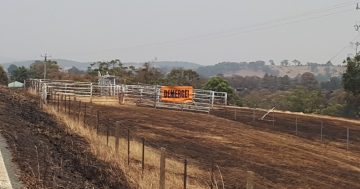
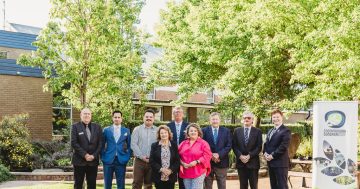
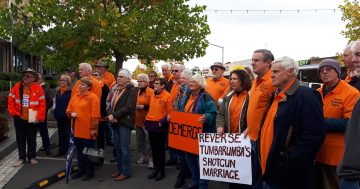
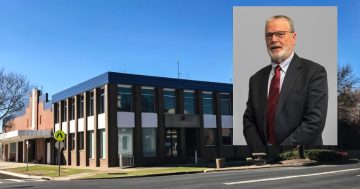
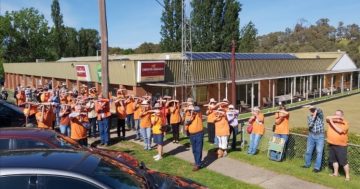
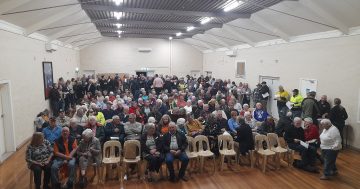
Residents from the Snowy Valleys and Cootamundra-Gundagai regions during community protests against the forced council amalgamations, which are progressing through the demerger process. Images: Gundagai Council in Exile & Save Tumbarumba Shire Inc Facebook.
The long-running push to unwind two of southern NSW’s most contentious council amalgamations has entered a new phase, with both Snowy Valleys Council (SVC) and Cootamundra-Gundagai Regional Council (CGRC) moving deeper into the complex work of demerger planning.
While the processes are unfolding separately, both councils are now focused on governance structures, financial modelling and transition planning ahead of the proposed creation of successor councils by July 2027.
In the Snowy Valleys, councillors will this week consider a series of recommendations designed to formally progress the de-amalgamation project following last year’s referendum result, which saw a majority of voters support splitting the council.
The proposed actions, to be presented at Thursday’s (21 May) council meeting in Tumut, include preparing a grant application to offset de-amalgamation costs, commissioning updated financial sustainability modelling for the two future councils and establishing new community consultation mechanisms.
Among the recommendations is the creation of a de-amalgamation steering committee under Section 355 of the Local Government Act, incorporating community representatives, alongside a separate community panel aimed at deeper consultation on key transition issues.
Council will also consider consulting residents on whether the SVC branding should continue and potentially be adopted by one of the successor councils once the split occurs.
The latest steps follow the appointment of chief transition officer Nicole Jenkins in April and recent discussions between council representatives and NSW Office of Local Government deputy secretary Brett Whitworth.
Ms Jenkins said ongoing community involvement would remain central to the process.
“The strong referendum result reflects the determination of the Snowy Valleys community, and it is essential that the transition to de-amalgamation continues to be community-led, transparent and informed by local voices,” she said.
“The recommendations being presented this month represent an important next step in progressing the de-amalgamation process in line with both state requirements and community expectations.”
The Snowy Valleys demerger traces back to the 2016 forced merger of the former Tumut and Tumbarumba shire councils under the NSW Government’s statewide local government reform program.
The amalgamation was controversial from the outset, particularly in Tumbarumba, where many residents argued the merger diluted local representation and failed to deliver promised efficiencies.
After years of community campaigning, the NSW Government approved a constitutional referendum in 2024, paving the way for residents to vote on whether the council should be split.
Meanwhile, the demerger of CGRC – another council created through the 2016 amalgamations – is continuing through a detailed planning process overseen by its Demerger Transition Committee.
At its April meeting, the council formally endorsed the membership of a Demerger Transition Disputes Resolution Panel, intended to independently handle any disagreements arising during the process.
The panel will be chaired by former local government executive Scott Phillips, who has previously served as general manager at multiple NSW councils and as chief executive of Local Government NSW.
Other members include Coolamon Shire general manager Tony Donoghue and mediator and conflict management specialist Michelle McFadyen, who has more than 20 years’ experience in senior local government executive roles across Queensland and NSW.
CGRC said the panel would only convene if matters were formally referred and anticipated few disputes requiring intervention.
The April transition committee meeting also marked a significant milestone in broader planning for the eventual separation of the council into the restored Cootamundra Shire Council and Gundagai Shire Council areas.
One of the major issues discussed was when to appoint the two future general managers, with the committee agreeing both positions should be filled by April next year.
Under the proposed structure, these two future GMs will spend the final months before demerger preparing organisational structures, recruiting staff, finalising strategic planning documents and ensuring the two successor councils are operational by 1 July 2027.
The committee also dealt with one of the trickier parts of the demerger process — how council money and assets will be split between the two future councils.
According to council, some funds, including water and sewer reserves, are legally tied to specific purposes and cannot simply be divided up freely.
For most other reserves, the committee has recommended working out where the money originally came from before the former councils were merged, and splitting it accordingly.
The meeting also marked the release of a tender for a new financial sustainability plan – a key document that will assess whether the two future councils can operate independently and remain financially viable after the split.
Tender submissions are expected to be considered by the committee in June.
The demerger process at CGRC followed years of political and community division after the forced merger of the former Cootamundra and Gundagai councils.
Like Snowy Valleys, many residents argued the amalgamation failed to reflect local identities and created governance challenges across geographically and socially distinct communities.
Both demerger processes remain subject to oversight from the NSW Government.