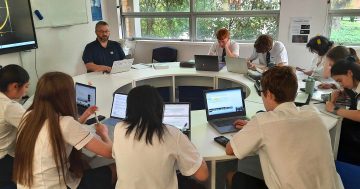
Students at St Michael’s Primary School, Kaleen, with teacher Erica Tokich. Numeracy will be given greater emphasis. Photo: Michelle Kroll.
Catholic archdiocesan schools face another wave of reforms that will embed church social teachings across the curriculum, as part of a 10-year strategic plan unveiled today.
Catholic Education Canberra and Goulburn launched its Apostolic Action Plan this morning at a major event in the National Convention Centre.
The plan has two main goals: for faith to “oxygenate” all areas of the curriculum in every classroom, and for all schools to achieve above-expected growth in literacy and numeracy.
It will build on the successful Catalyst high-impact teaching program, but there will be extra emphasis on numeracy where feedback showed more work was needed to lift standards.
The role of technology, including devices and artificial intelligence, will also be reviewed.
The plan calls for a holistic, integrated curriculum rather than separate subject silos, in which teachers will find meaningful connections across disciplines.
It maps out a 25 per cent growth in CECG’s capacity from 24,000 to 30,000 students and an expansion of its footprint, including a new co-ed secondary school on Canberra’s southside.
CEGC Executive Director David de Carvalho said the plan aimed to address a crisis of meaning for young people that had been accelerated by technology use and social media.
Mr de Carvalho told the launch that the well-documented increase in mental health issues was also symptomatic of a cultural crisis, at the bottom of which was a crisis of faith.
He said the curriculum overhaul sought to remedy this by offering a culture of hope.
But incorporating Catholic teaching on areas such as social justice and dignity, more broadly, into the curriculum did not mean inserting the Bible or the Catechism into the classroom.
Mr de Carvalho said a Catholic curriculum was not a “doctrinally Catholic syllabus for teaching fractions, French grammar or the causes of the First World War”.
“Nor is it about creating strained connections between the religious education curriculum and other learning areas, in a way that dilutes disciplinary rigour, though it does encourage making such connections in an authentic way where appropriate,” he said.
Nor would it mean sanitising reading lists or avoiding contentious issues.

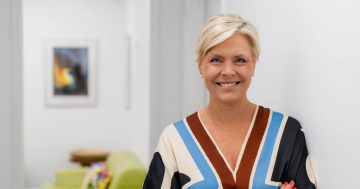
CEGC executive director David de Carvalho: “We don’t just want students to learn facts and information but to understand what it means.” Photo: Catholic Weekly.
Mr de Carvalho said the plan challenged both staff and students to address the big questions of life and to question their own motivations for what they do and believe.
“We don’t just want students to learn facts and information but to understand what it means,” he said.
Nonetheless, Religious Education will be given a higher profile, with more professional development and the role of religious education leader elevated to assistant principal level.
The plan also envisages greater engagement between schools, families and school community councils, with the appointment of dedicated school-family liaison officers to be trialled.
Schools will also discuss with families and students the risks and benefits of digital technologies, including devices, social media and AI.
Speaking ahead of the launch, Mr de Carvalho said work on the plan had been ongoing for the past year, taking its lead from Pope Leo’s apostolic letter Drawing New Maps of Hope and his 2026 encyclical, as well as feedback from staff.
Mr de Carvalho said the current three-year operational plan concluded this year.
He said the detail of the curriculum overhaul would be co-designed with staff through discipline-based working groups.
“In the first instance, it’s about seeing how your discipline has connections with other disciplines,” Mr de Carvalho said.
“So we’re not coming in saying, ‘OK, we’re going to insert all this Catholic teaching into your thing’, that’ll just drive people nuts.
“We’re wanting to choose literature, poems, plays, novels that help students address the big questions in life, the questions that faith is trying to address.
“You’re teaching them with a view to helping them understand the world more at a deeper level and reflect on their own role in that world.”
Mr de Carvalho said parents were concerned about the world their kids were about to enter, and Catholic schools wanted to offer a vision of life that was more hopeful and centred on community, rather than just seeing education as an individual enterprise.
An AI working group had been set up, and CECG was taking a cautious and considered approach.
“We’re exploring how we can help teachers learn about AI and how they might be able to use it to benefit them in a way that doesn’t deskill them,” he said.
“The real question is, what do we do in the classroom with it? We know it’s a huge problem at universities, and this is why the NSW Education Minister has asked the Education Standards Authority there to consider putting a pause on or a moratorium on take-home assignments that are part of the HSC.”
While not all teachers in the system were required to be Catholic, they would need to articulate the Catholic position on topics as they arose in the classroom.
“You mightn’t necessarily agree with it, but you’ve got to understand it at least, and be able to say, ‘well, this is what the church teaches and why’,” Mr de Carvalho said.
He acknowledged that there was a small risk of alienating some families by making faith a more prominent part of school life, but schools would remain welcoming.
“We want to be invitational. The archbishop’s very strong on this. It’s propositional, not impositional,” Mr de Carvalho said.
While the CECG wanted to grow its footprint, this still had to be grounded in faith, he said.
Original Article published by Ian Bushnell on Region Canberra.