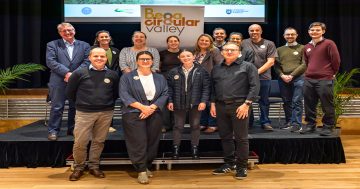
Circularity is set to become a major influence in the Bega Valley. Photo David Rogers.
Whether it’s an individual act of recycling or a large company reducing waste, circular economy experts believe there is money to be made, money to be saved and additional jobs to be generated.
Now a group of scientists aim to put some figures on sustainability by measuring what is happening in the Bega Valley.
Working with the community, businesses and Bega Valley Shire Council, a joint CSIRO-Regional Circularity Co-operative (RCC) team will build the first comprehensive picture of how materials and resources flow through the Bega Valley, looking at current waste, reuse and recycling practises, to see how they could be improved and how the shire could benefit.
The 18-month investigation is part of a circularity baselining project which aims to map material flows in the Valley, how materials are used, find opportunities for using them for longer and how, when ordinarily they might have reached the end of their life, they can be turned into something else rather than ending up at the tip.
The project is not simply about reuse and recycling but includes looking for new business opportunities and economies of scale when purchasing. It also aims to understand the relative social and environmental merits of any opportunities.
The Bega Group is part of the project and executive chairman Barry Irvin is also chairman of the RCC. He believes the Bega Valley is uniquely placed to test the application of the national circular economy framework.

From fish waste to a fertiliser. Photo Ocean2Earth.
“There is one council, one airport, two roads in and out with a good mix of types and sizes of industry across agriculture, aquaculture, fisheries, forestry, tourism, manufacturing, healthcare, services and more,” Mr Irvin said.
“We can measure everything in this Valley and we can prove what worked and what didn’t really quickly.”
A circular economy is an economic model designed to minimise waste and make the most of resources by keeping materials and products in use for as long as possible.
Unlike the traditional linear economy where products are made, used and then discarded, the circular economy focuses on designing systems where materials are reused, repaired, refurbished, remanufactured or recycled.
RCC regional circularity baselining coordinator Gemma Edwards said the project would look at all aspects of the circular economy in the Bega Valley from a very granular level through to large organisations.
But while they would be looking at what is currently happening, the project team would also investigate whether there were other opportunities, as yet unrealised.
Ms Edwards said these could be in aggregating spend for businesses in the same industry to get economies of scale or the development of local jobs through the discovery that one business’s trash could be another’s treasure, known as industrial symbiosis.
One example is local fertiliser company Ocean2Earth which picks up the organic waste such as fish heads and offal from South Coast Fish Processors in Eden to turn them into fertiliser. Another is the Recycling Technologies Group in Eden where wood fibre waste is turned into wood pellets and briquettes used as heating fuel.
Ms Edwards said site visits were planned to Bega Valley Shire Council and to Bega Cheese.
“They will be part of the first site visits but we will be looking to talk to a broad range of businesses in multiple site visits throughout the project,” Ms Edwards said.
“We don’t know where the conversations will take us. We’re working on a rhizome strategy, where connections and ideas may spread in many directions.”
Mr Irvin said the Bega Valley baselining project had a bigger role to play at an international level.
“On an international scale, this project could become the template for how to measure and progress circularity within a region. We want to be able to share knowledge and findings with our partners and our networks to help accelerate transitions in other places too,” Mr Irvin said.
Anyone who is interested in being part of the working group, has some data or something at the end of their business/manufacturing process that could be used elsewhere, contact Ms Edwards at [email protected]