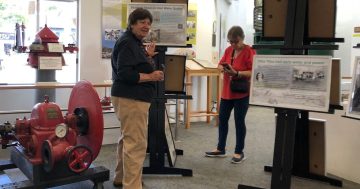
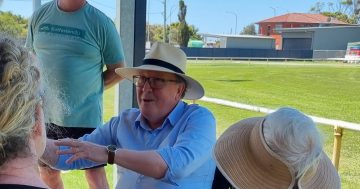
Narooma Bridge being inspected. Photos: Supplied.
A major refurbishment of a component that plays a critical role in raising and lowering Narooma Bridge’s opening span has been completed.
The bridge that carries the Princes Highway over the Wagonga River has state historical significance because it was the first major bridge constructed on the Princes Highway by the newly formed Mains Roads Board (MRB). It also has state technical significance because it represents a significant and rare variation of the bascule opening span. It was the first of only two of this design built in NSW. It is listed on the Roads and Traffic Authority’s Heritage and Conservation Register.
It is an exceptionally rare surviving example of the Strauss bascule design used in NSW between 1927 and 1936, and NSW’s last operational Strauss bascule bridge.
It has two fixed steel truss spans and was the first bridge in Australia with a cantilever bascule lifting span that could be operated by one man. It originally took the single operator 30 minutes to lift and close the bridge.
The lifting span is a single leaf bascule weighing 63.5 tonnes hinged with a counterbalance.
Work started on the steel truss bridge in 1929 and it was officially opened on 20 June 1931.
Transport for NSW (TfNSW) recently refurbished the bridge’s worm drive, a nearly three-tonne component that plays a vital role in raising and lowering the opening span.

The part being installed.
The bridge was closed for around two hours in June while crews removed support beams and lifted the worm drive from the structure.
It was transported by barge to a workshop in Bega where TfNSW staff worked with a specialist contractor to inspect, clean and refurbish the mechanism and manufacture replacement parts. The work included improved lubrication, replacement of worn components, electrical upgrades and operational testing.
The mechanism was restored in keeping with its original design, while incorporating modern seals to reduce the environmental risk of oil leakage. A new electric drive and sealed input gearbox were also installed to improve reliability.
The worm drive was successfully reinstalled during a shorter bridge closure in late July.
Laurelle Pacey’s book Narooma’s Past contains considerable information about the bridge’s history.
According to the book, Noorooma residents began lobbying the Minister for Works for a bridge across the inlet soon after the ferry service was established in 1894. However landowners and business people who used Wagonga Wharf were opposed because they thought a bridge would prevent navigation to Wagonga Wharf and shipment of their produce such as butter, cheese, pigs, girders and sleepers.
The bridge was designed by the MRB, and Newcastle engineers Morrison and Bearby Ltd built and delivered it to Narooma.

It is NSW’s last operational Strauss bascule bridge.
The three-span steelwork was assembled in Newcastle one section at a time, then taken to pieces again and brought to Narooma by the steamer Kianga in three shipments. The steel was unloaded at the town wharf and taken to the site by bullock team.
At the official opening ceremony local member H J Bate described the opening as a “consummation of a long and overwhelming desire to link up the two parts of this great highway – a highway that not only is a road, but an artery along which flows our commerce, our mails and our passenger service”.
He told the crowd of around 1800 that the state, not ratepayers, would bear the construction and maintenance costs. Construction cost 42,000 pounds.
After the official speeches, he threw a dart at a “chocolate wheel” to decide who would be first to walk across the bridge. The dart hit number 95, so that privilege went to Donny Southam, head sawyer at Mitchell’s Mill. All proceeds from the draw went to the Narooma Soldiers’ Memorial Hall fund.
A “sumptuous spread” including Narooma oysters followed, then a six-team knockout football competition at the recreation ground and a grand ball that evening.
In 1960 the bascule span was modified by adding an electric motor and adjustments were made to the counterweight. The hand-driven mechanism was left intact and usable.
Member for Bega Dr Michael Holland said the bridge was part of the fabric and history of Narooma and the Far South Coast.
“It’s remarkable to think that machinery installed almost a century ago is still doing the job it was designed to do,” he said. “It is a bridge built to last, and this work will help ensure it continues to do just that.”
Further strengthening and repainting work is planned to begin on Narooma Bridge in 2027, with TfNSW to keep the community updated as planning progresses.