Mick Brosnan, Social Justice Advocates of the Sapphire Coast, and Kylie Furnell, SEWACS Youth Accommodation Program. Photo: Ian Campbell.
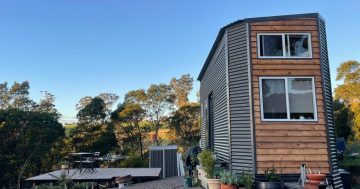
The NSW Land and Environment Court’s ruling on a tiny home on wheels on a rural property in Coolagolite potentially makes it even more difficult for charities to help the homeless.
In 2025 Bega Valley Shire Council issued compliance orders requiring the demolition or removal of the tiny home on wheels and cessation of occupation. It said the tiny home was a “building” that required development consent under the Environment and Planning Assessment (EPA) Act 1979 and therefore was not approved for habitation.
On 9 September the court determined that occupation had to cease although demolition was not required.
The ruling has implications for some of the operations of the Social Justice Advocates of the Sapphire Coast (SJA). It has been providing crisis accommodation for more than 13 years.
Since the not-for-profit launched the ‘It’s Up To Us’ campaign in June 2021 to increase the shire’s supply of crisis accommodation, the community has supported it with more than $500,000 funding. SJA used some of that to provide eight crisis transitional units or moveable dwellings to complement the more than 75 caravans that it uses for crisis accommodation.
Three went to land owned and occupied by Bega Uniting Church and five went to Reflections Pambula Holiday Park.
After a lengthy legal stoush between SJA and council, in December 2025 SJA and council found a pathway for transitional crisis accommodation to be approved on the Bega Uniting Church site.
Around the same time Reflections requested that the five transitional units at Pambula be vacated.
Ian Ritchie is a member of SJA. He said that 85 per cent of the tenants who had been in the eight transitional housing units went on to secure permanent rental accommodation.
Mission Australia selects the tenants, and they are managed by a local real estate agent. They go in as paying tenants with government rental assistance.
“The object is they get a track record of paying rent,” Mr Ritchie said. “The aim is to transition them every three months.”
He said the fastest growing demographic of the homeless were single women over the age of 55 due to factors such as insufficient superannuation, domestic violence, or marital breakup.

The tiny home at the rural property in Coolagolite. Photo: Supplied.
In a statement to Region, Reflections said it operated holiday parks on Crown Land in accordance with the Crown Land Management Act.
Under the Holiday Parks (Long Term Casual) Act it had authorised Reflections Pambula to allocate five long-term casual sites for SJA’s units for short-term use by people experiencing homelessness. The act permits long-term casual agreement holders to use a site for holiday purposes for up to 180 days of the year. It also requires that the agreement holders have a permanent address elsewhere. In November 2025 Reflections requested that the dwellings be vacated because SJA had exceeded the 180-day period. Additionally, concerns were raised about the safety of holiday park guests following several occupant behaviour issues that required police intervention.
“Reflections had instigated a memorandum of understanding (MOU) process. The intent was to continue occupation under agreed conditions while further review could take place for any alternate longer-term option that would meet the requirements of the act,” it said. “Reflections has been advised that there is no viable pathway for this proposed MOU under the act.”
In a statement to Region, council said the recent court decision reinforced its long-held position that where a dwelling was used to provide separate residential accommodation from the primary dwelling on a property, development consent was generally required, regardless of whether it was a conventional building or a moveable dwelling.
“Property owners who wish to support the provision of housing, including crisis and transitional accommodation initiatives, can seek development approval for a secondary dwelling on the land. Depending on the circumstances, that secondary dwelling may be a conventional building or a moveable dwelling such as a tiny home. The key requirement is that the development is assessed and approved through the appropriate planning process.
“The court’s decision does not prevent the use of tiny homes or other innovative housing solutions. Rather, it confirms that where they are being used as separate dwellings, the appropriate planning approvals are required.”
In the meantime, SJA has received an offer of seven tiny homes at no cost.
“We currently have offers of land from private property owners to put those transitional housing units on, but we can’t take them up because of council’s stance on tiny homes,” Mr Ritchie said.