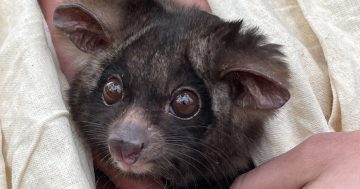
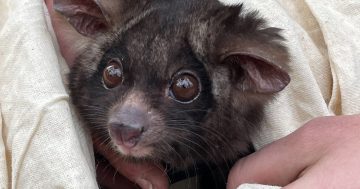
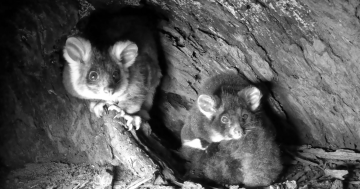
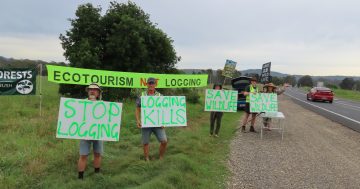
Andrew Wong of Wilderness Australia urges the government to halt logging in Glenbog and other critical Greater Glider habitats, warning that practical conservation solutions have been ignored. Photo: Wilderness Australia.
The fate of a critical population of endangered Greater Gliders and vulnerable Yellow-bellied Gliders in the southern NSW high country will be debated this week as locals and wildlife carers meet with the Forestry Corporation of NSW in a bid to protect 515 hectares of Glenbog State Forest from logging.
The 12 March meeting brings together community members, wildlife carers and experts from a coalition of conservation organisations, including Humane World for Animals Australia, to press for protection of one of the region’s most important high-value wildlife habitats.
Located south-east of Cooma on the Great Eastern Escarpment, Glenbog contains tall eucalypt-dominated old-growth forest with mature hollow-bearing trees – some over a century old. Its cool, moist environment provides a rare refuge during extreme heat, drought and bushfires, making it a critical stronghold for threatened wildlife.
As with any state forest managed by the Forestry Corporation of NSW, Glenbog is subject to logging rules designed to protect threatened species and their habitat.
These regulations require surveys to identify key habitat features, such as hollow-bearing trees used by wildlife, ensuring timber harvesting avoids critical shelter – for example, Greater Glider dens are protected by a mandatory 50-metre exclusion zone.
At the centre of the Glenbog dispute is a stark discrepancy between the Forestry Corporation’s pre-logging survey work and independent findings by citizen scientists.
While Forestry Corporation surveys recorded just four Greater Glider den trees in the planned logging area, volunteer survey teams identified 102 den trees.
Community volunteers have also documented 112 hollows in old-growth trees actively used by Greater Gliders, underscoring the forest’s value as habitat.
Campaigners say part of the difference in survey outcomes stems from survey timing and methods.
Volunteer groups spent weeks conducting night-time surveys, often in cold or challenging conditions, while Forestry Corporation pre-logging surveys, they say, were typically carried out during daylight hours, when nocturnal gliders are less active and harder to detect.
According to Doro Babeck, of the Bob Brown Foundation, this discrepancy shows why thorough, on-the-ground surveys were critical for protecting endangered species.
“Forestry Corporation’s wilful disregard for its regulatory duty to properly survey and protect endangered species before logging shows once again that it cannot be trusted to manage our state forests,” she said.
Bird habitat and other threatened species are also part of the debate.
Key threatened species identified in the area, often relying on old-growth hollows, include the Gang-gang Cockatoo, Powerful Owl, Sooty Owl and Flame Robin.
After partnering with BirdLife Southern NSW, community surveyors say they found multiple threatened bird species in the proposed logging area, along with clear signs of breeding.
The Forestry Corporation’s own voluntary protocol also requires all wombat burrows in Glenbog to be protected.
A large-scale survey led by Jarake Wildlife Sanctuary has recorded 801 wombat burrows across the operation so far.
Local wildlife carers say wombats were previously buried alive in Glenbog as their burrows were collapsed by logging machinery.
Humane World for Animals Australia wildlife program manager Dr Renae Charalambous emphasised the fragility of these species.
“Both the Greater Glider and the Yellow-bellied Glider rely entirely on the hollows of old-growth trees for shelter,” she said. “Once these trees are logged, there’s simply nowhere for them to go.
“Glenbog is one of the last unprotected places where these species still survive side by side, and it should be safeguarded from further logging.”
The Forestry Corporation of NSW has emphasised that timber harvesting in Glenbog has not commenced and any claims to the contrary are incorrect.
While operations are included in forward planning, they remain in the planning phase pending completion of required surveys and regulatory safeguards, they say.
“All timber harvesting operations must comply with NSW’s detailed environmental regulations, which were developed with input from expert scientific panels,” a Forestry Corporation spokesperson said.
“These plans include requirements to complete ecology searches and to identify and protect environmental features and threatened species habitat.
“We also engage with a variety of stakeholders during planning, and local staff are meeting with various stakeholders as part of that process.”
Conservationists say the meeting on 12 March is a crucial moment to ensure logging does not proceed in areas of high conservation value, and to press the Forestry Corporation to reconsider planned harvests.
Andrew Wong of Wilderness Australia said the government must act to protect Greater Glider habitat, calling for an immediate logging moratorium in Glenbog, Styx River, Clouds Creek, Bulga, Flat Rock, Tallaganda and Nalbaugh state forests, followed by a rapid state-wide scientific assessment of critical habitat. Practical solutions, he says, have so far been ignored.