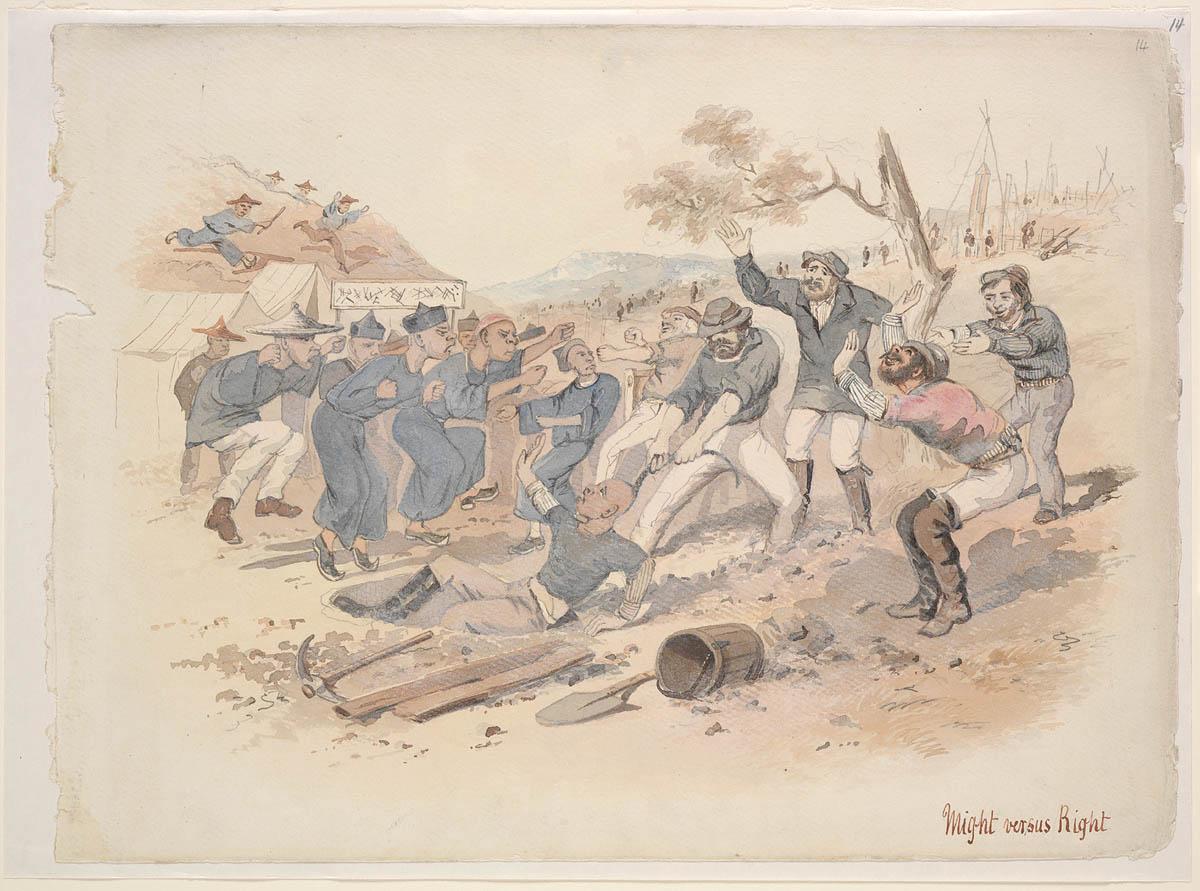
An of-the-era white interpretation of what happened at the Burrangong goldfields, Might versus Right, by Samuel Thomas Gill, c. 1862-1863. Image: Samuel Thomas Gill/State Library of NSW.
The names of 94 Chinese miners who were at the Lambing Flat riots on 30 June, 1861, have been uploaded to the Chindex Chinese Name Search — making them publicly searchable for the first time.
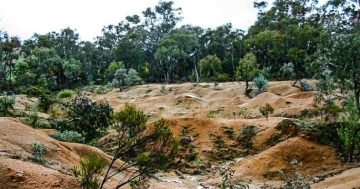
Lambing Flat, the goldfields settlement now known as the Hilltops town of Young, was the site of some of the most violent anti-Chinese disturbances of Australia’s gold rush era.
For Australians with Chinese heritage who have long suspected a family connection to that dark chapter of history, this is the place to start looking.
Chindex is an online search system that queries multiple historical datasets in a single pass.
It is based on Tim Sherratt’s GLAM Name Search — a free tool built to search across the collections of galleries, libraries, archives and museums simultaneously — adapted specifically for Chinese Australian research.
The challenge here is name variation: a single person may appear in dozens of forms across colonial records, shaped by dialect, the ear of the clerk and the whim of whoever held the pen.
Chindex cuts through that by searching national archives, state passenger lists, Births, Deaths and Marriages records, and the many smaller databases held by community organisations and individuals — all at once.
To understand why the date of 30 June, 1861, is so significant, it helps to know what happened to the men behind those names.
Unlike their European counterparts, Chinese miners often worked in cooperative groups, meticulously reworking abandoned claims and recovering gold from areas others had deemed exhausted.
Their success, coupled with existing racial hostility, led to resentment among European diggers.
Among those caught up in the rising violence was Su San Ling Doh, whose story gives a human face to what can otherwise remain an abstraction of numbers and dates.
Su had arrived at Lambing Flat on 22 December, 1860, carrying a miner’s right from the Snowy River at Kiandra.
Within two days of starting work, European miners were demanding the Chinese leave.
He requested time to remove his belongings and was refused.
When he returned the following day, he found his tent burnt and £300 worth of possessions stolen.
In his petition to the Governor — presented to the Legislative Assembly by Henry Parkes on 14 March, 1861, months before the worst of the riots, Su pointed out plainly that he held a licence to be on the field and had expected, but did not receive, the protection of the law.
His petition, and those of others, led to the appointment of a Special Commissioner to consider compensation claims.
But before many claimants could be heard, the worst of the violence arrived.
On 30 June, 1861, thousands of European miners stormed the Chinese camps, torching tents, looting possessions and brutally assaulting those who could not escape.
More than 1000 Chinese miners and shopkeepers fled into the surrounding bush, many injured and destitute.
Despite requests that compensation hearings be held in Bathurst or Sydney, claimants were required to return to Lambing Flat in person.
Commissioner William Campbell ultimately examined 1568 Chinese claims for damages totalling £40,623 and recommended that £4240 be paid to 706 individuals — meaning more than half of all claimants were excluded from compensation altogether, even before the bureaucratic delays and translation problems that meant many of those 706 never received a penny either.
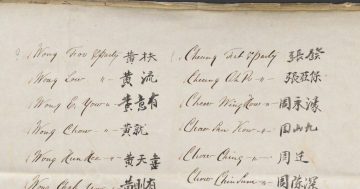
Nearly three years later, in April 1864, 94 Chinese men assembled at Tuena on the Abercrombie River, between Bathurst and Goulburn, to record their names on a petition — in both Chinese and English — attesting that they had been present at Back Creek on 30 June, 1861, and driven from the field.
Two of those petitions are now preserved in the Museums of History NSW State Archive Collection and have been brought to wider public attention by Our Chinese Past, a not-for-profit organisation dedicated to preserving and promoting Chinese-Australian history.
When a name appears on that petition, it places a real person at that precise moment in history, which is why genealogists regard the document as such an important find.
And thanks to Chindex, those names can now be searched for the first time.
“By making these records accessible, we hope to assist descendants in uncovering lost family connections and ensure this history is not forgotten.”
The value of Chindex is best illustrated by a case study, researched and written by Juanita Kwok.
Wong Sat (1837-1916) is one of the best-known early Chinese Australians.
He ran a general store near Crookwell from around 1880 until his death in 1916, and the remarkable collection of stock, artefacts and documents that survived from that store can be viewed at the Powerhouse Museum in Sydney.
Much is known about his later life — yet, according to his great-granddaughter Dawn Wong, the seven years between 1857 and 1864 remain a mystery.
Three pieces of circumstantial evidence place Wong Sat at Tuena in 1864 when the petition was signed, connect his wife’s family to the linguist who presented the petitioners’ case and link him through family story to the Lambing Flat riots themselves.
While this information doesn’t prove he was actually at Lambing Flat, the case shows how Chindex, pulling together multiple datasets in a single search, can surface connections that would otherwise remain buried.
Read the full case study at ourchinesepast.org.au.
Thanks to the Museums of History NSW, which granted permission for the petitions to be reproduced, the names of those affected were not lost, and thanks to Chindex, they are now findable.
For anyone with a Chinese ancestor who may have been on the NSW goldfields in 1861, that is exactly where to start.