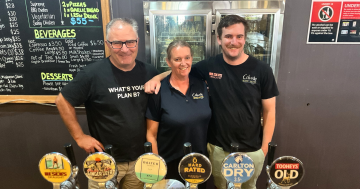
Cobargo publican David Allen has described current policy concerning illegal tobacco as a “farcical situation”. Photo: Michelle Kroll.
Southern NSW communities are missing out on sponsorships while illegal cigarette sellers acquire “Robin Hood status”.
That claim was made during a recent hearing into the illegal tobacco crisis, held by the Senate Legal and Constitutional Affairs References Committee.
Long-time business owner Marney Wishart said her Junee business was only open because her elderly parents had put money into it for the first time, as some customers turned to illegal sellers.
“In my area, they’ve reached Robin Hood status,” she said of illegal suppliers.
“The government of the day is so hated that people think it’s funny they’re taking those funds away from the government.”
She said the impacts were extending beyond local businesses and said she was left unable to sponsor community groups and teams because of a drop in her business’s income.
“When the four local schools, when CanAssist, the swimming club, the football club and soccer club all come in for donations, they’re guaranteed it – or they were,” she said.
“I haven’t been able to donate for two years, which is horrible as a member of the community. They know not to even ask now, because they know the condition I’m in.”
She urged government action to fix the price gap between legal and illegal tobacco products.
“Business 101 – the only way you can succeed in business is to compete with your nearest competitor,” she said.
“We’re not doing that.”
Far South Coast publican David Allen previously told Region he was seriously considering closing his tills for tobacco sales.
He told the inquiry the decision had been made – he wouldn’t be renewing his license in August amid a loss of trade and fears of criminality.
“We have lost 85 per cent of cigarette and tobacco trade in our bottle shop … We can’t sustain that. That money is just going to criminals,” he said.
Mr Allen urged the panel to crack down on the tobacco excise tax, pointing to a cut the Canadian government made in the 1990s.
He said this would strengthen legal sellers and provide an alternative to illegal sales.
“If you do not have control of the market, you cannot do anything – plain packaging becomes moot.”
Canadian-born academic Becky Freeman, who also appeared at the inquiry, pushed back on the suggestion of following Canada’s approach.
When asked about the change by the panel, she said its effect was an increase in Canada’s young people smoking. She said Australia existed in a different regulatory context.
“[In Australia, we] have 32-odd years of tobacco control in place … There was no plain packaging, there was no social media [in Canada at the time of the change].”
She also called for solutions to address supply and labelled current enforcement measures “woeful”.
During the inquiry, Bega Valley Shire Council Mayor Russell Fitzpatrick said the higher price of legal tobacco products was driving smokers to the illegal alternative, which was hitting particularly hard in lower socioeconomic areas of the shire.
“At the present time, there’s no way that people can afford that [in] the socioeconomic base that we work off in the regional area we’re in,” he said.
The council’s director of community, environment and development Emily Harrison said there needed to be resources at a local level.
“[That will mean] enough resourcing to inspect and shut places down, but to do the follow-up, or to be there when we do say, ‘They’re open again, someone needs to get back’ to be able to enforce that.
“We’re not seeing that at the moment.”
Ms Harrison said that in NSW, a development application currently wasn’t needed for many changes of use for retail premises, which limited a council’s oversight abilities.
“We have no powers or leavers to regulate what shops are where. … From a planning perspective, we don’t have powers to take action where shops are selling illicit tobacco or vapes.”