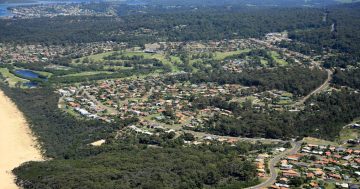
Bega Saleyards and surrounding land, which has been the subject of BVSC rezoning proposals as part of a 279-hectare urban development. Photo BVSC.
A proposal to rezone 279 hectares of land south of Bega has prompted 137 written submissions to Bega Valley Shire Council, with the top concern the proximity to, and impact on, the Bega Saleyards.
The proposal outlines the development of three new neighbourhoods, supported by infrastructure such as roads, utilities and open spaces. If approved, the rezoning could enable the construction of about 2230 dwellings.
The land in question is currently zoned as rural, rural residential or productivity support. The new zoning would include a mix of low-density and rural residential housing, commercial areas and public open spaces.
The proposal has been through the NSW Gateway approval process and BVSC has released its Community Consultation Report, in which the five most frequently raised issues were: saleyards impact, infrastructure capacity, loss of agricultural land, scale too large, and traffic and congestion. There were also environmental and flood risk concerns as well as a preference for alternatives to a greenfield expansion.
However, many accepted the need for growth and rezoning to provide new homes and encourage affordability, but questioned aspects of the rezoning proposal. There was support for population growth and workforce needs, and for strengthening Bega as a regional hub.
BVSC said several housing types were supported in the R2 low-density residential zone.
“Small dwellings and small lot sizes are supported in the R2 zone, which enables subdivision of vacant land down to 350 square metres and the creation of lots as small as 150 square metres for existing dwellings,” BVSC said, adding that units with ground-floor access, apartments and shop-top housing were all permissible in the proposed E1 local centre and E2 commercial centre zones.

BVSC plans showing the proposed rezoning areas in south Bega. The areas closest to the saleyards would be R2 low-density residential. Image: BVSC.
Housing design and the issue of roof-to-roof heat island patterns were also a concern, particularly in the 550 sqm divisions. There was a call for adequate setbacks to allow for light and ventilation and north-facing blocks. The council said many of these issues were incorporated into the review of the Development Control Plan.
The Bega Saleyards topped the list of concerns, but BVSC said the site was currently surrounded by E4 General Industrial zone, a Crown Land Travelling Stock Route reserve (zoned RU2) and C2 Environmental Conservation zones along the waterways. These were not proposed to change and would provide a buffer against noise, odours and any complaints about the saleyards’ operation.


Measures to minimise impacts on nearby residents included physical separation buffers, such as roads and setbacks between proposed housing and other uses, and applying R5 Large Lot Residential zones as a transition and to provide space for separation, landscaping and reduced sensitivity, BVSC said in response to the concerns.
There were also questions about infrastructure, such as sewerage, water, electricity and stormwater, and health and education facilities. BVSC said most of the local infrastructure required to support future development would be developer-funded.
“Developers will be responsible for either delivering infrastructure directly or contributing financially towards infrastructure,” BVSC said, adding that a new Local Infrastructure Contributions Plan for the urban release area would be prepared to identify local infrastructure required to support growth and set developer contribution rates to help fund the work.
BVSC envisages the use of Voluntary Planning Agreements, a mechanism that can provide the council and developers with greater flexibility and potential cost savings. These can include land dedication for open space or recreation areas, pathways around developments or contributions towards state or regional infrastructure.
“To ensure growth does not occur without a funding pathway, the rezoning proposal includes safeguards to ensure that infrastructure must be funded before development proceeds,” BVSC said.
The council was also confident that future water supply needs could be accommodated by the existing Bega bore field, and that urban growth would not compromise agricultural or environmental water requirements.
“Estimated additional water demand sits within the existing licensed annual extraction limit, and even during drought conditions, the aquifer will have sufficient stored water, with only slightly faster groundwater drawdown,” BVSC said.
The NSW Government has approved the project to move forward. The public consultation aims to help refine the proposal. Council staff have been in consultation with state agencies following the completion of the public exhibition period regarding biodiversity and flood hazards. Once this process is completed, the final planning proposal addressing public and agency submissions will be presented to the council for final consideration before the end of the year.