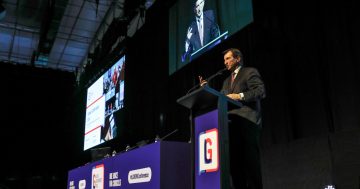
NSW Minister for Local Government Ron Hoenig addresses media. Photo: Supplied.
NSW local councils and the public face more uncertainty about transparency after the NSW Upper House disallowed the NSW Government’s controversial rewrite of the Model Meeting Code.
The revised code, which came into effect in January, banned private briefings to councillors by council staff.
The ban was overturned on 26 May when members of the Liberals, Nationals, the Greens and Mark Latham disallowed the regulation that enacts the code.
The revised code had introduced several changes. One key change was banning private briefings.
For years council staff have privately briefed councillors on council meeting agenda items in advance of meetings.
It meant ratepayers had no idea what council staff had told councillors, including what alternatives had been explored. The only sources of information for ratepayers were the papers that council staff prepared for the council meeting and attending or livestreaming council meetings to see if any additional information or explanation emerged before councillors voted on an agenda item.
Eurobodalla Shire Council took the approach of holding workshops to brief councillors on more complex and technical items such as the Batemans Bay Masterplan and the Batemans Bay Flood Risk Management Plan. The workshops were open for the public to observe.
The workshops appeared to be effective, but it was not possible to hold workshops on every weighty issue that came before the councillors. At the April and May council meetings some councillors expressed frustration that the prohibition on private briefings made it difficult to make informed decisions in the limited time available.

Griffith councillor Mark Dal Bon asks a question. Photo: Oliver Jacques.
In a press release on 27 May the NSW Office of Local Government said the Upper House had reactivated the ability for NSW councils to hold private briefing sessions, undoing measures the government introduced to increase transparency and public confidence in local government.
“Every council will now be burdened with unnecessary confusion and uncertainty as the transparency and other measures contained in the new code need to be wound back by each of NSW’s 128 councils,” it said. It said the Upper House move had “thrown the baby out with the bathwater”.
Eurobodalla Deputy Mayor Colleen Turner, a member of the Greens, said Dr Amanda Cohn from the Greens was the driving force behind the Legislative Council disallowing the 2026 code. Dr Cohn was advised by the more than 70 Greens councillors across NSW. None of them found the new code to be an improvement.
Cr Turner said as well as banning briefings, the code had several other regressive features including an increase in power and deference to mayors versus councillors and disallowing councillors’ attendance by Zoom unless unwell or with caring responsibilities.
“Councillors at Eurobodalla all found restrictions on briefings made our considerable workload more onerous,” she said.
“I found the briefings that were held as open to the public very useful and would be happy for those to continue,” Cr Turner said. “They allow councillors and community to be better informed and so to make better decisions.”
The NSW Government’s media release said it had agreed to consider a number of wording amendments to address any unintended consequences in the new code. That was mainly in response to issues raised by rural and regional councils where the circumstances can be unique to a particular area.

Minister for Local Government Ron Hoenig met with Cootamundra-Gundagai Regional councillors. Photo: Ron Hoenig Facebook.
“The government is now considering options in relation to these long overdue reforms which were introduced to improve the transparency and decency of council meetings and reduce corruption risks,” it said.
Bernie O’Neil, co-convenor of A Better Eurobodalla community group, said over the course of finalising the reforms something went awry.
A discussion paper in September 2024 said there would be no more private briefings and that the only ones that would be allowed would be open to the public. “Then in the final draft of the Code of Meeting Practice it went from no private briefings to no briefings,” she said.
“We think in the interests of transparency and good governance, briefings should be allowed and should be open to the public,” Ms O’Neil said.
She said councils still had the provision to have a closed session, for example when something that was commercial in confidence was being discussed or personnel matters.
“Otherwise, why not have the public hear what council staff tell councillors,” Ms O’Neil said. “There is no apparent logic why the public should not be privy to that.”