


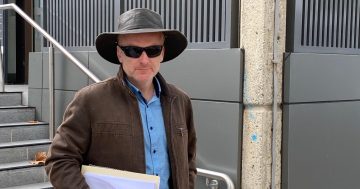
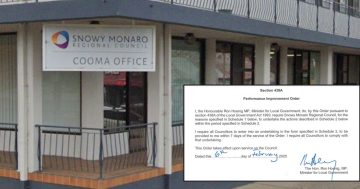
The Snowy Monaro Regional Council (SMRC) offices in Cooma and (right) Cr Andrew Thaler. Multiple proceedings involving the councillor remain ongoing. Photo composite: Region.
Snowy Monaro councillor Andrew Thaler has been the subject of three misconduct findings and multiple suspensions since May last year, yet remains on the council as a series of legal and administrative proceedings continue to play out.
The situation has prompted questions from residents about how NSW’s councillor conduct system works, what powers are available to regulators and councils, and when a councillor can ultimately be disqualified from office.
The issue has again been thrust into the spotlight following recent proceedings in the Industrial Relations Commission of NSW (IRC), where Snowy Monaro Regional Council (SMRC) CEO Noreen Vu is seeking stop-bullying orders against Cr Thaler.
Unlike the councillor conduct process, which deals with alleged breaches of the code of conduct, the IRC matter concerns workplace bullying allegations and is being heard under separate legislation.
Stop-bullying orders were introduced for NSW local government workers in 2025 and allow the IRC to intervene where workplace bullying is alleged.
During the hearing, Ms Vu alleged Cr Thaler’s conduct towards her had been persistent and made her feel unsafe.
Cr Thaler denied his conduct amounted to bullying, arguing his comments constituted legitimate criticism and political communication.
IRC Commissioner Christopher Muir has reserved his decision, with final written submissions to close on 12 June before a formal judgment is delivered.
Meanwhile, Cr Thaler has also faced three separate investigations by the NSW Office of Local Government (OLG), resulting in three misconduct findings against him since May 2025.
“Councillor Thaler was given a three-month suspension for each of the findings of misconduct, which he has served,” an OLG spokesperson said.
However, one of those suspensions, served between 5 August and 4 November 2025, was later overturned on appeal by the NSW Civil and Administrative Tribunal (NCAT), which upheld the misconduct finding itself but substituted a reprimand for the three-month suspension.
The OLG has appealed that decision to the NSW Court of Appeal, where a directions hearing is scheduled for Wednesday (10 June).
The outcome will determine whether the overturned suspension is reinstated and whether Cr Thaler meets the threshold for automatic disqualification under the Local Government Act.
The OLG said the councillor conduct framework was designed to maintain accountability and public confidence in local government.
“The principle of public trust in elected officials is vital, and all councillors are expected to uphold the high standards rightly expected of them by the communities they serve,” an OLG spokesperson said.
“The NSW Government expects councillors to conduct themselves with respect, integrity and in the public interest.”
The spokesperson also said no-one should be subjected to bullying or intimidation at work and that councils had a duty of care to ensure the health and safety of their workers.
Under NSW’s councillor conduct framework, councils are responsible for dealing with code of conduct complaints in the first instance, with some matters able to be referred to the OLG.

SMRC would not comment on the allegations or ongoing proceedings.
“Out of respect for the administrative and legal proceedings currently underway, it would be inappropriate for council to comment at this time,” a spokesperson said.
In response to questions from Region, Cr Thaler said he did not accept the findings made against him through the councillor conduct process.
“No. These matters remain before the courts and it would be inappropriate to comment,” he said.
Asked whether he accepted some of his comments regarding Ms Vu had gone too far, Cr Thaler said he had made that concession during the IRC proceedings, but only in the context of allegations he strongly disputes.
“I did make that concession, on the basis that Ms Vu impugned that I had an improper interest in a minor, which I completely reject,” he said.
“Ms Vu said this repeatedly in writing deliberately to annoy me, which it did.”
Cr Thaler also rejected suggestions his conduct had damaged public confidence in SMRC.
“No. I was elected to do a job, to bring change and weed out corruption,” he said.
“The weeds are holding fast to their ground, and I have not given up.”
Asked what he would say to residents who believe repeated suspensions expose weaknesses in the accountability system, Cr Thaler said the problem was not the conduct framework itself.
“The weakness in the system is that it covers up for corrupt conduct,” he said.
Cr Thaler also defended his criticism of council staff.
“Absolutely. It is also true and legitimate political communication.”
He said he had no intention of changing the way he publicly engaged with council staff.
“No, because some of the staff are lying about my engagement with them, to the point of extreme and obtuse exaggeration.”
The allegations and counter-allegations have also drawn attention to broader questions about workplace safety obligations within local government, particularly around the management of psychosocial risks such as bullying and harassment.
SafeWork NSW said it was not involved in the matter currently before the IRC and could not comment on the specific case.
However, a spokesperson said councils, like any employer, had a duty of care to ensure the health and safety of workers.
“Managing psychosocial risks at work is a SafeWork NSW focus area and is one of five regulatory priorities,” the spokesperson said.
“Under NSW work health and safety laws, workplaces are required to protect their workers from harm to their psychological health and safety. This includes taking proactive steps to prevent bullying and harassment.”
SafeWork NSW said it had the power to make inquiries into workplace safety issues, issue notices and take enforcement action where required.
The NSW Government introduced the Local Government and Other Legislation Amendment (Councillor Conduct) Bill 2025 into Parliament last year.
The bill remains before Parliament and has not yet been introduced, meaning the current councillor conduct framework continues to apply.
If the bill is enacted, serious councillor misconduct matters would be referred to the Land and Environment Court, which would have the power to impose longer suspensions, disqualify councillors from office for up to five years, order interim suspensions in some circumstances and impose financial penalties.
For many Snowy Monaro residents, the issue is no longer simply about one councillor or one workplace dispute.
With multiple proceedings still underway, the broader question is whether the current system is capable of resolving repeated conduct disputes while maintaining public confidence in local government and ensuring procedural fairness for all involved.










Despite branding itself as a sustainable "wellness community", clearing and developing 125 hectares… View