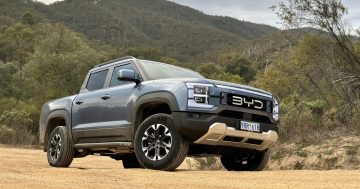
The GWM Cannon Alpha PHEV offers an electric range of over 100 km – but is that much good out here? Photo: James Coleman.
As soon as you cross the border into South Australia, it begins. Not every car, but certainly every Toyota LandCruiser, which is about every second car. A wave from the driver as you pass, sometimes two fingers, sometimes a whole hand.
At least, I thought it was a wave. Because after spending two weeks traipsing over at least the tissue surrounding the heart of Australia – if not the heart itself – you very quickly realise the driver is more likely just batting a pesky fly away.
Even the locals, from Broken Hill to Port Augusta, all remarked on how diabolically bad the flies are at the moment – dive bombing every orifice the moment you step outdoors.

At the gate for the Daydream Mine, near Broken Hill. Photo: James Coleman.
It’s enough to make you want to remain in your car at all times. Which, when you’re driving 5000 km to a place and back, is not hard.
Yep, for the Easter school holidays, my wife and I decided to pack ourselves and the three kids into the car and head into the desert. Ostensibly to visit our brand new nephew in Quorn, a small town about three hours north of Adelaide between the toes of the Flinders Ranges.
But the trip also had another important mission. Finding out if China’s new plug-in hybrid ute can do it. And for less than a diesel – which is actually a far closer competition than it sounds, even with diesel prices soaring like a wedge-tailed eagle over $3 a litre.

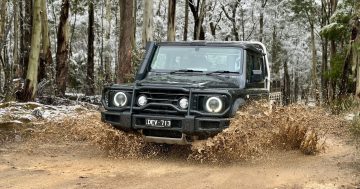
In the mud at Warren Gorge, near Quorn, SA. Photo: James Coleman.
You’ve heard of the BYD Shark 6, as by far and away the best-selling PHEV in Australia.
Then there’s the plug-in-able Ford Ranger, but with a dismal electric-only range of 49 km, you’re probably better off using the battery for nothing more than powering the worksite coffee machine.
But completing the PHEV ute trifecta, at least for now, is this – the GWM Cannon Alpha.
And on paper, there’s something very tempting about 114 km of electric range – for a total of over 1000 km and claimed average fuel consumption of 1.7 litres per 100 km.
And not only looking like it means business, but coming with actual mechanical front and rear diff locks and a low-range gearbox. This car pulled its way up Queensland’s fearsome Beer O’Clock Hill don’t you know? A place the BYD Shark flailed like a fish out of water.
But my question is what happens when that battery runs out and you’re charging 2810 kg of block-shaped object through the air at 110 km/h with nothing more than a 2-litre four-cylinder turbo petrol engine.
And before long, we got our answer.
Canberra – Wagga Wagga (2h 45m, 246 km)
You can forget the Great Walls of yore. From the inside, it’s hard to tell this is a ute and not a Mercedes SUV.
Parts of the design might be a bit gauche, like the light-up graphic of its front end on the passenger-side of the dash. But the materials seem hard-wearing. Not even Tiny Teddies ground into the rear seats left a mark.
And there’s heaps of space, even if the spare wheel in the tray smacks of a Friday-afternoon job.

At the fuel station in Wagga – the first of many more to come. Photo: James Coleman.
Maybe it’s to do with its sheer weight, but the rear doesn’t bounce around like a lot of unladen utes. It handles as calmly as any SUV. The steering is nicely direct and – once you get used to the tug when lifting your foot off the throttle – the regenerative braking is fairly subtle too.
And the best part?
While there is more variety for the diesel and petrol-hybrid versions of the Cannon Alpha, the PHEV comes in two models – the Lux from $59,990 and the Ultra from $66,990.


That’s only $4K more than the BYD and even after some price hacking, comfortably under the Ranger PHEV.
Really the only thing that always caused me to cower in shame from the GWM – or consider leaving it unlocked – was the little jingle it plays from a front-mounted speaker when you lock it. Just flash your indicators like everyone else. Please.
Wagga Wagga – Broken Hill (8h 42m, 848 km)
Powered from a household socket, it took us nearly the two nights we spent in Wagga to get the GWM’s battery back up to full.
But quite impressively, it then lasted the full 97 km to Narrandera, where there is a handy EV charging station.
However, the dead-straight highway over the Hay Plains – where the wind is barely interrupted by so much as an anthill – proved my fears. Average fuel consumption shot up to around 12 litres per 100 km. That 1000 km of range became 700. By Mildura, the tank was dry.


Another half a tank got us to Broken Hill, along a similarly dull highway if it weren’t for the sunset. Being so flat, you can watch in real time as it slides below the horizon like it’s made of cardboard and in a children’s book.
We also discovered the GWM’s massage function for the driver and passenger seats at this point, which was a Godsend.
Broken Hill – Quorn (4h 24m, 411 km)
Broken Hill exudes proper outback-town vibes, probably because it is. It’s only a stone’s throw from the South Australian border.
But it’s also a ghost of its former self and walking through it on a Sunday afternoon, dead. In the early 1900s, population ballooned to nearly 30,000, captured by the allure of striking it rich in the silver, zinc and lead mines. Nowadays, it barely cracks 18,000.
You can almost see all of them from atop BHP’s 30 m high mullock dump that towers over the town like the Eye of Sauron.

The Line of Lode Miners Memorial, Broken Hill. Photo: James Coleman.
Up here is also a memorial to all the miners who have died over the years and you can wash down the resultant gulp in your throat from the nearby café. And take a seat on the Big Bench, which is exactly as it sounds.
One of the few mines in the area you can actually enter is Daydream Mine, located further north along the road to Silverton (named in that truly imaginative Australian spirit as a town that had a lot of silver in it).
There are more strong outback feels as we head off the highway and onto a red dirt road for several kilometres.


The mine itself dates from the 1880s and today extends its tentacles of tunnels nearly 400 m below the surface. It was worked largely by Cornish migrants – sometimes children – for 12 hours a day, and by little more than candlelight.
The owner explains how Broken Hill’s cemetery is the largest in inland NSW for a reason – miners were dead by 30, lungs cut to pieces by silica dust.
By this point, our lungs are simply full of flies, so it’s back on the road to escape them and make our final run across the border.
There are lot of towns out here that are literally blink-and-you’ll-miss-them, with the only sign you’ve been through it the “Thank you for visiting X Town” on the way out.

Quorn – the gateway to the Flinders Ranges. Photo: James Coleman.
Quorn isn’t one of these.
Not only does it have an IGA, two pubs, a golf course, an oval with open-air gym equipment, a gin distillery, a petrol station, a café that sells pop-quorn chicken (I had to include that), there’s even an outdoor swimming pool. Almost more than can be said of Canberra.
Quorn has also starred in several films over the years, including The Sundowners, Sunday Too Far Away, Gallipoli, The Shiralee and Russell Crowe’s The Water Diviner.
But for every man over the age of 50 out there, it’s a veritable nirvana for another reason.


The Ghan train used to run through Quorn and has left its tracks in the form of the Pichi Richi Railway, which winds its way through the dramatic rocky hills to Port Augusta.
And during the April school holidays and again in May, they put a steam locomotive on it.
All up, it’s a 2.5-hour return trip from the Quorn-Railway-Station-turned-visitor-centre to partway down the line at Woolshed Flat, but even as a young man – ostensibly “doing it for the kids” – it was probably the highlight of our entire holiday.
Quorn is also the gateway to the Flinders Ranges. Which means it’s also the ideal place to get the GWM dirty and try out those diff locks.
Just north of Quorn is a private camp site called Argadells, which – for the privilege of $60 – will let you let your 4WD loose on their track.
They say it offers some of the best views of the area, but we’ll take their word for it, because on the day we tried to go, spitting rain had turned the clay into quagmire and the track was closed.
We ended up continuing several more kilometres along a dirt road instead – with a rocky creek crossing thrown in for good measure – enough to realise that from the factory at least, the Cannon Alpha isn’t up to much.

It needed a wash anyway. Photo: James Coleman.
Those tyres are simply too smooth to grip and the steel battery casing hangs down too low in the rear to exit steep climbs without dragging.
That said, it could still tackle a beach.
As much as we Canberrans are duty bound to swear under duress that the beaches of the South Coast are the best in the world, about an hour’s drive south west of Quorn has them beat.
Point Lowly, near Whyalla, is all clear, warm waters and white sand – proper postcard ‘grammable stuff. Provided you ignore the LPG and diesel storage facility right next door.
But it’s also one of the few beaches in the area you can drive onto. So of course we did, bearing in mind all I could about being gentle on the throttle and avoiding the fluffiest sand so it didn’t end in hopeless tyre-spinning. It didn’t.
So the beach still looks pretty – I guess is what I’m saying.


Quorn – Adelaide (3h 37m, 336 km)
It’s a slightly jarring transition, going from desert-adjacent conditions – if not outright desert – to the rolling green hills of the Barossa Valley. But not a bad one by any stretch.
A search for kid-friendly wineries where we were not likely to piss off too many Halliday zealots turned up Kies Family Wines, located not far from the vineyards of big names like Jacobs Creek and Grant Burge.
I’m not a connoisseur by any stretch and largely think “notes of oak and chocolate” are concocted after having too much of said drink and just making it up.


But my wife and I shared a tasting selection of the local wines and they were all very nice. Especially when combined with a charcuterie board and meals for the kids for just over $100.
We spent the next two nights close to Adelaide’s centre, enough to admire its leafy streets, stately old buildings, pleasing grid layout and actual synchronised traffic lights – something I thought impossible, from my life commuting Drakeford Drive.
Adelaide – Hay (7h, 655 km)
At this point, we’re thankful our Prime Minister appeared to us as in a vision with his bargain $20 million advertising campaign on how drivers can save fuel.
The third service station we pulled into had a working air pump, so accordingly we bumped up our tyre pressures a considerable few PSI.
And you’ll be glad to know your $20 million was well spent, because it made … no difference to our fuel consumption. Between Hahndorf and our stopover in Hay, we averaged 10.2 litres per 100 km.


Hahndorf is a taster of what Australia could have been like if Germany won the war, albeit the few upsides. Like pubs serving Krombacher and schnitzels, cafes selling Reuben sandwiches and apple strudels and cute craft shops selling nutcracker soldiers and cuckoo clocks.
It was established in 1839 in the Adelaide Hills by a handful of Lutheran families fleeing persecution in Prussia, even if nowadays it’s all about ducking and weaving between tourists. Like Mogo, on German steroids.
Hay – Canberra (5h 34m, 509 km)
All up, we spent about $750 on petrol over the course of our roadtrip. Which averages out at nearly 15 cents a kilometre.
And when you look at the new hybrid Toyota Prado, which averages 7.6 km per 100 km and offers more than 1400 km of range, it’s hard not to think we could have done better.
For highway driving, or towing, or off-roading, diesel is still undisputed king.

The fuel bill totalled about $750. Photo: James Coleman.
But here’s the thing. If you didn’t have to hand it back at the end and could return to normal life driving to and from work, you’d save so much fuel in this the odd roadtrip wouldn’t matter. Your credit would still be miles ahead.
So as it stands, the GWM was very comfortable, hugely spacious and capable of almost everything an almost normal family threw at it.
And I say “almost normal” because of the flies. They drive you insane.
2026 GWM Cannon Alpha PHEV Ultra
- $66,990 (plus driveaway costs)
- 2.0-litre four-cylinder turbo-petrol engine and electric motor, 300 kW / 750 Nm
- 9-speed automatic, 4WD
- 1.7 litres per 100 km claimed fuel consumption
- 115 km claimed electric driving range
- 3500 kg braked towing capacity
- 2810 kg weight
- 5-star ANCAP safety rating
- 7-year, unlimited-kilometre warranty
Thanks to GWM Australia for providing this car for testing. Region has no commercial arrangement with GWM Australia.
Original Article published by James Coleman on Region Canberra.